

Dropshipping From China to Kenya: Why It Rarely Works and What to Do Instead

Dropshipping from China to Kenya rarely works, because every customer order travels from China as its own parcel. That means weeks of waiting, import duty and VAT assessed on each parcel when it lands, no realistic way to offer cash on delivery, and returns that cost more than the product. The model that does work for a small online shop is small batch importing: buy 20 to 50 units of a product you have tested, ship them as one load, and deliver from Nairobi the next day. Pamoja Imports ships those batches under one all-in rate that already includes duty, VAT, IDF, RDL and clearance.
- How Does Dropshipping From China to Kenya Work?
- Is Dropshipping Profitable in Kenya?
- What Happens to a Single Parcel at Kenyan Customs?
- Why Do Cash on Delivery and Returns Break the Model?
- When Does Dropshipping in Kenya Actually Work?
- What Is Small Batch Importing, and Why Does It Beat Parcels?
- What Does a Small Batch Cost Compared With Parcels?
- How Do You Start an Online Shop in Kenya With a Small First Batch?
- Which Mistakes Sink New Online Sellers?
- Frequently Asked Questions
How Does Dropshipping From China to Kenya Work?
Dropshipping from China to Kenya means you sell a product online without holding stock, and a Chinese supplier posts each order straight to your customer in Kenya. You never touch the product: you list it, collect the payment, place the order with the supplier, and wait for the parcel to reach the buyer.
The model became popular through Shopify tutorials and YouTube channels aimed at the US and European markets. In those markets it can make sense, because delivery networks are fast and shoppers are used to paying by card before they receive anything. The pitch is the same everywhere: no stock, no warehouse, start with almost no money.
The steps look simple on paper:
- You pick a product from a Chinese retail marketplace and list it in your own online shop, on social media or on a marketplace, at a higher price.
- A customer in Nairobi, Mombasa or Kisumu orders and pays you.
- You pay the supplier the product price and the shipping, and give them the customer’s address.
- The supplier posts the parcel. It flies to Kenya, goes through customs, and is handed to a local carrier or the postal service for delivery.
- You keep the difference between what the customer paid and what you paid the supplier.
Every step after the third is out of your hands. That is the core problem with dropshipping in Kenya: the part of the business your customer judges you on, which is how fast and how cleanly the product arrives, is the part you cannot control. The next sections go through where it breaks.
Is Dropshipping Profitable in Kenya?
For most sellers, no. Dropshipping in Kenya can show a profit on a single order, but the margin rarely survives delivery delays, customs charges, refused parcels and the advertising needed to replace unhappy customers.
So the honest answer to “is dropshipping profitable in Kenya” depends on what you count. A product that costs the equivalent of 600 ksh in China and sells for 2,000 ksh on Instagram looks like a strong margin. Then add what each order really carries:
- Advertising: the cost of the clicks and messages it took to win that one buyer.
- Shipping: either a slow free option built into the product price, or a paid express option that can cost more than the product.
- Customs: duty and VAT on the parcel, which someone has to pay before it is released.
- Failed orders: customers who cancel after three weeks of waiting, refuse to pay a customs bill, or ask for a refund.
- Refunds: when the product is wrong or damaged, you refund the customer and the supplier rarely refunds you in full.
The guides that rank for this question are mostly written by companies selling dropshipping plugins, store builders or payment tools. They list “low startup cost” as the main advantage and say little about what happens to a parcel after it leaves China. None of the ones we read worked out what a single parcel costs to land in Kenya, or who pays the customs bill.
Each of those costs grows with the waiting time. The longer a parcel takes, the more customers cancel, chase you on WhatsApp, or leave a bad review, and the more you spend on ads to replace them. A shop that holds stock in Kenya removes most of that list at once, which is why the rest of this guide focuses on that route.

What Happens to a Single Parcel at Kenyan Customs?
A parcel from China is assessed for import duty and VAT when it arrives in Kenya, and the charge is collected from the person receiving it before the parcel is released. When you are dropshipping, that person is your customer, who paid you for the product and is not expecting a second bill.
We could not find any KRA or Posta Kenya page that sets a value below which parcels come in free of duty and VAT. Third-party sites quote several different thresholds, and they contradict each other, so we do not repeat any of them here. Plan on the basis that a dutiable parcel will be charged.
Postal parcels are handled by Posta Kenya, which offers customs clearance for incoming dutiable items. Commercial imports are a different matter: KRA’s own guide says importing goods such as machinery requires a customs clearing agent, and goods bought for resale are commercial, not personal.
One Kenyan buyer who documented an AliExpress order of a smartwatch paid 1,031 ksh in customs duty at Posta and waited roughly two months from dispatch to collection. That account dates from late 2021, so treat it as an illustration of how the process feels rather than a current rate.
On top of duty and VAT, Kenyan imports carry the Import Declaration Fee (IDF) and the Railway Development Levy (RDL), and the duty band depends on the product. Our guide to Kenya import duty from China shows how they stack. With one parcel per customer, you face that calculation, and that collection step, for every single sale.
How long does a dropshipped parcel take to reach Kenya?
Expect weeks, not days, on the free or cheap shipping options. Published estimates disagree: one 2026 guide lists 35 to 60 days for AliExpress standard shipping to Kenya, while another puts standard at 15 to 30 days. Neither explains how it measured the figures, which is itself a warning: you cannot promise your customer a delivery date you cannot predict.
Why Do Cash on Delivery and Returns Break the Model?
Cash on delivery breaks dropshipping because you must pay the supplier in China before the parcel ships, weeks before your customer pays you. Returns break it because sending a product back to China costs more than the product is worth, so every return becomes a full loss.
Most of our clients sell through WhatsApp, Instagram, TikTok and Facebook, where Kenyan buyers commonly expect to pay when the product reaches them. A buyer who has never heard of your shop will rarely send money upfront for something that arrives a month later. That leaves you two choices with dropshipping:
- Ask for payment upfront and lose most buyers who do not know you yet.
- Offer cash on delivery, pay the supplier yourself, and carry the risk that the customer has changed their mind, moved, or refuses the parcel when the customs bill arrives with it.
A refused parcel is the worst case. You have paid the supplier, you have paid for the ads that won the order, and the parcel is either stuck at the post office or on its way back to a supplier who may not refund you.
Returns follow the same logic. A customer who receives the wrong size or a faulty item wants a replacement now. If your stock is in China, a replacement is another month away. If your stock is in Nairobi, you swap it the next day and keep the customer.

When Does Dropshipping in Kenya Actually Work?
Dropshipping in Kenya works when the supplier is in Kenya, not China. If a Nairobi wholesaler holds the stock and delivers to your customer the same day or the next, you can sell without stock and still offer cash on delivery.
That version of the model has its own limits. Local wholesalers usually import from China themselves, so their price already includes their freight, their duty and their margin. You are competing with them and with every other reseller using the same wholesaler, on the same product, often with the same photos. The margin is thin, and it is only as reliable as the wholesaler’s stock levels.
Dropshipping straight from China can also work in a narrow case: very light, high-value items for buyers who already trust you, who pay upfront, and who accept a long wait, such as a specialist part for a hobby or a professional tool that is simply not available in Kenya. Those orders are real, but they rarely add up to a business on their own.
For everything else, the stronger option is to hold a small amount of your own stock in Kenya, bought directly from China.

What Is Small Batch Importing, and Why Does It Beat Parcels?
Small batch importing means buying a modest quantity of one product, often 20 to 50 units, and shipping it from China to Kenya as one consolidated load instead of as separate parcels. You pay freight and customs once for the whole batch, then sell and deliver from Kenya.
The difference shows up in every weak point of dropshipping:
| Issue | Dropshipping from China | Small batch importing |
|---|---|---|
| Delivery to your customer | Weeks, date hard to predict | Same or next day from your stock in Kenya |
| Duty and VAT | Assessed on every parcel, often billed to your customer | Paid once for the batch; with us it is inside the all-in rate |
| Cash on delivery | Risky: you pay the supplier weeks before the customer pays you | Practical: the product is already in Kenya |
| Returns and swaps | A return to China usually costs more than the product | Swap from stock the next day |
| Product checks | You never see the product | You check the batch before you sell it |
| Upfront money | Low per order | Higher once, lower per unit |
The only column where dropshipping wins is upfront money, and the gap is smaller than it looks. You do not need a container. A small batch can go by air from 1 kg, or by sea from 0.1 CBM, through our China warehouse.
When you work with Pamoja Imports, small batch importing looks like this. Your supplier, or the supplier we find for you, delivers the batch to our China warehouse; suppliers with the goods in stock usually get there in 2 to 3 days. Shipments leave the warehouse usually once a week. By air, goods are cleared and ready at our Kenya warehouse 7 to 14 days after departure; ordinary goods are often ready closer to 7 days, while electronics and other goods airlines treat as dangerous goods take longer to clear. By sea it is 30 to 45 days. Our shipping timeline guide breaks down each stage.
If your batch comes from more than one supplier, we combine it into one shipment. Our consolidated shipping guide explains how that works and what it costs.
Pamoja Imports: ship your first batch instead of single parcels
Air freight is 1,700 ksh per kg and sea freight 65,000 ksh per CBM, both all-in: duty, VAT, IDF, RDL and clearance are included. Your batch arrives cleared at our Nairobi or Mombasa warehouse, ready for you to sell.
What Does a Small Batch Cost Compared With Parcels?
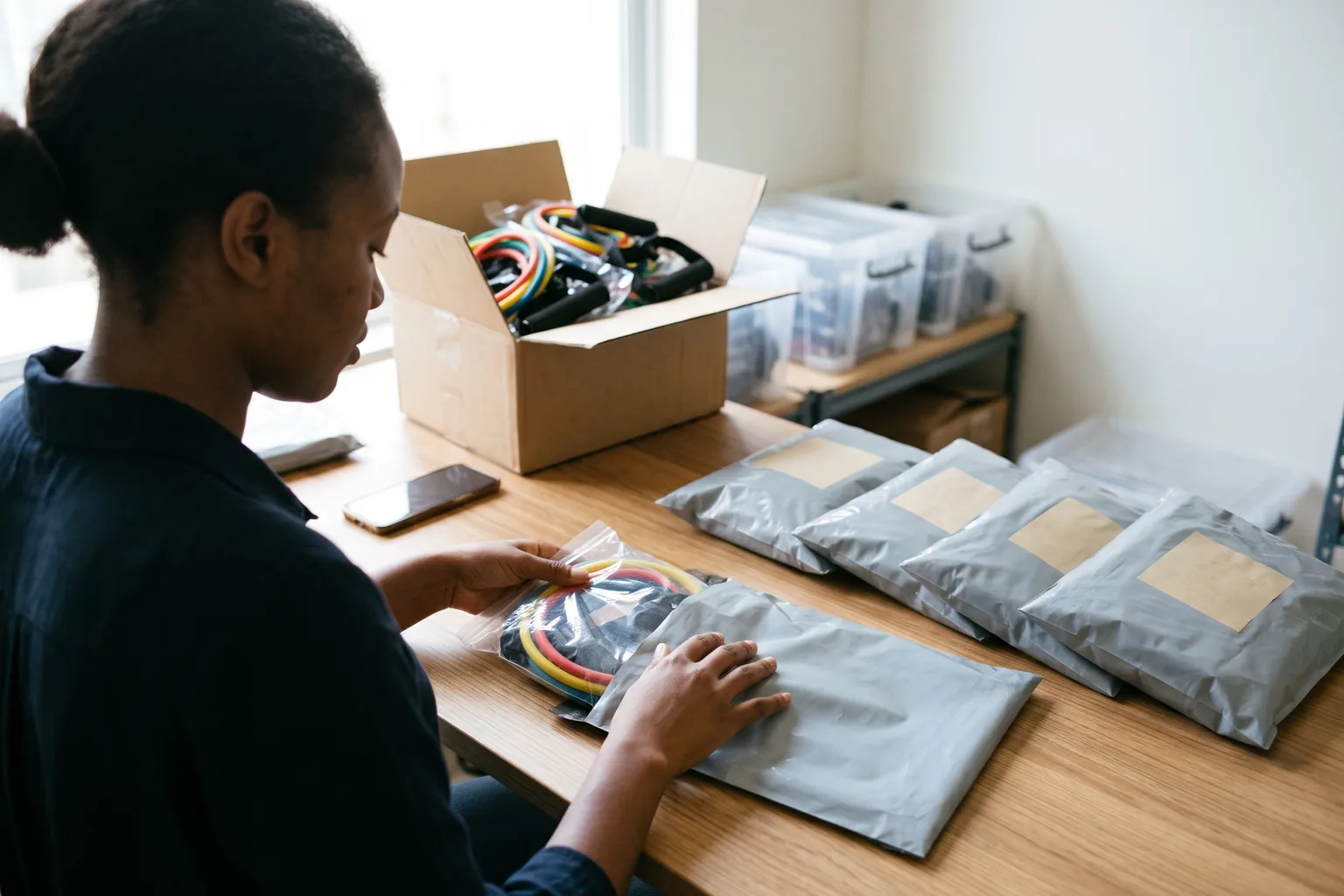
A small batch usually costs a few hundred shillings per unit to land in Kenya with duty and taxes included, while a single parcel on a fast courier can cost a few thousand shillings before any customs charge. The example below uses our published rates and a made-up order of 50 resistance band sets, a light product that is often sold online.
The small batch: 50 resistance band sets from one supplier
The supplier packs the 50 sets into one carton of 50 x 40 x 30 cm that weighs 9 kg. For air freight we charge the higher of the real weight and the volumetric weight, which is length x width x height in cm divided by 6,000. Here that is 60,000 / 6,000 = 10 kg, so the chargeable weight is 10 kg.
| Item | By air | By sea |
|---|---|---|
| Size charged | 10 kg (volumetric) | 0.1 CBM (the minimum; the carton is 0.06 CBM) |
| Freight at our all-in rate (duty, VAT, IDF, RDL and clearance included) | 17,000 ksh (10 kg x 1,700 ksh) | 6,500 ksh (0.1 CBM x 65,000 ksh) |
| Shipping deposit (7.5% of freight, minimum 2,500 ksh) | 2,500 ksh (the minimum) | 2,500 ksh (the minimum) |
| Consolidation fee | None (one supplier) | None (one supplier) |
| Total shipping | 19,500 ksh | 9,000 ksh |
| Per set | 390 ksh | 180 ksh |
| Ready at our Kenya warehouse | 7 to 14 days after departure | 30 to 45 days after departure |
The product cost is what you pay your supplier and is not in the table. Collection from our warehouse is free; if you want us to deliver, a separate last-mile fee applies. You pay the shipping deposit upfront and the freight when the goods arrive at our Kenya warehouse. Use our shipping calculator to run your own cartons.
The parcel route: the same 50 sets, one customer at a time
On the parcel route, each of the 50 customers gets their own parcel. One 2026 guide lists express courier options from China at $15 to $60 or more per parcel, which is about 1,950 to 7,800 ksh at the Central Bank of Kenya rate of roughly 130 ksh to the dollar in November 2026. We could not find a second published source for that range, so treat it as one guide’s estimate. Duty and VAT come on top, assessed parcel by parcel.
The free and cheap options avoid that cost, but they are the ones with the 15 to 60 day estimates above, and duty and VAT still apply on arrival. Either way, dropshipping from China to Kenya costs you more per unit, takes longer, or both, and it leaves the customs bill with your customer.
How Do You Start an Online Shop in Kenya With a Small First Batch?
To start an online shop in Kenya without the dropshipping problems, test demand first, then buy one small batch of the product that proved itself, ship it in one load, and sell from stock in Kenya. Keep the first batch small enough that you can sell all of it even if demand is weaker than you hoped.
A practical order of steps:
Test demand before you pay for stock
Post the product on your WhatsApp status, Instagram or TikTok with the supplier’s photos and a price, and count real enquiries. Ten serious buyers asking for a delivery date tell you more than a hundred likes.
Cost: your timeWork out the landed cost per unit
Add the supplier price, the per-unit shipping from a quote, and your delivery cost to the customer. If the margin does not hold at the batch size you can afford, change the product, not the maths.
Tools: shipping and profit calculatorsCheck a sample or the first cartons
For a new supplier, a sample or a small first batch shows you the quality your customers will see. We ask suppliers for a photo of the sealed, marked cartons before they dispatch to our China warehouse.
Lowers the risk of a whole batch going wrongShip one batch, by air first if speed matters
Air gets a first batch to market quickly while the demand you tested is still warm. Once a product sells steadily, move the repeat orders to sea, where the cost per unit drops.
Air from 1 kg, sea from 0.1 CBMSell from stock and reorder before you run out
With stock in Kenya you can offer next-day delivery and cash on delivery. Reorder when you have sold about half the batch, so the next one arrives before the shelf is empty.
Turns one test into a repeat businessIf you already have a supplier, the shipping-only route is simple. You give your supplier our contact, we collect the package details and quote you, and once you have paid the shipping deposit we send the shipping mark and warehouse details directly to your supplier. Sending it straight to the supplier means fewer hand-offs where text gets lost, and the supplier can ask us directly if anything is unclear.
If you do not have a supplier yet, send us the product as a photo, link or specification. We search Pinduoduo, 1688 and Taobao through our team in Chengdu and quote you a product price and shipping. Sourcing is free, with a minimum product order of 30,000 ksh. For a wider plan, see our guides on how to start an import business in Kenya and how to sell imported products in Kenya, and our list of the best products to import from China to Kenya.
Which Mistakes Sink New Online Sellers?
The mistakes that sink new online sellers are buying too much of an untested product, pricing without the full landed cost, and promising delivery dates they cannot control. All three are avoidable with a small first batch and a written quote.
The wider list is in our guide to mistakes to avoid when importing from China to Kenya.
Frequently Asked Questions: Dropshipping From China to Kenya
For more answers to common questions about importing from China to Kenya, visit our Kenya import FAQ page.
You can, but you carry the risk. You pay the supplier in China before the parcel ships, and the customer only pays when it arrives weeks later, if they still want it and accept any customs charge. Cash on delivery is practical when the stock is already in Kenya.
Duty and VAT are assessed when the parcel arrives and are collected from the person receiving it before release. In dropshipping that is usually your customer, unless you pay the charges for them, which comes out of your margin.
Enough to test real demand and small enough to sell within a few weeks. For a light product that is often 20 to 50 units. Size the batch to the cash you can afford to leave in stock, not to the cheapest per-unit price.
There is no minimum product order for shipping-only clients who already have a supplier. Air freight has a 1 kg minimum and sea freight a 0.1 CBM minimum, and the shipping deposit is at least 2,500 ksh. If we source the product for you, the minimum product order is 30,000 ksh.
Yes. If a Nairobi wholesaler holds the stock and delivers to your customer, delivery is fast and cash on delivery works. The trade-off is a thinner margin, because the wholesaler has already added their own freight, duty and profit.
With us, air takes 7 to 14 days and sea 30 to 45 days, counted from the China warehouse departure until the goods are cleared and ready at our Kenya warehouse. Ordinary goods by air are often ready closer to 7 days; electronics and other dangerous goods take longer to clear.
Ready to Ship Your First Batch?
Send us your supplier’s details or the product you want, and we will quote one all-in price to our Kenya warehouse.
Need Sourcing? I Have a Supplier
Jonatan Sirak sirak.se
Founder of Pamoja Imports, a Kenya-China import agency with an operations team based in Chengdu, China. Based in China since 2018, he studied Mandarin and built direct factory relationships in Chengdu, and now helps Kenyan entrepreneurs source and import products profitably. He splits his time between Nairobi and Chengdu.