
Import Packaging From China to Kenya: Best 2026 Guide
Import packaging from China to Kenya, in short: pick the box or carton, confirm its HS code, approve a printed sample and ship it flat by sea. Duty depends on the HS code, and imported paper cartons carry excise duty, at a rate the Finance Act 2025 changed. With Pamoja Imports, duty, VAT, the IDF fee, the RDL and clearance sit inside one all-in rate of 65,000 ksh per CBM by sea, including excise on paper cartons, so a flat-packed order is priced by volume alone.
- Why Import Packaging From China to Kenya?
- Which Packaging Is Worth Importing From China?
- What Is the Packaging Import Duty in Kenya?
- Does Excise Duty on Packaging Apply to Imports?
- Does Imported Packaging Need KEBS or PVoC Certification?
- Should You Ship Packaging by Sea or Air?
- How Do You Order Custom Packaging From China?
- How Does Pamoja Imports Handle a Packaging Order?
- What Mistakes Cost Packaging Importers Money?
- Frequently Asked Questions: Import Packaging From China to Kenya
Why Import Packaging From China to Kenya?
You should import packaging from China to Kenya when you need a size, material or print that local suppliers do not stock, in a quantity that justifies sea freight. Chinese factories make almost every kind of box, carton and label, and most of them print your own design directly onto it.
Gift boxes come up regularly in the sourcing requests we receive from Kenyan clients. The people asking are usually not packaging dealers. They are small brands that sell their own products, hamper and gift sellers, online shops that ship parcels and workshops that need cartons for their own goods. For them, a box with their logo in the right size is part of the product, and a generic box from a Nairobi stockist does not do the same job.
There is one honest limit. Plain brown boxes in standard sizes are rarely worth importing, because local suppliers already stock them and empty boxes are bulky to ship. The saving comes from custom sizes, custom print and finishes that are hard to get locally, or from a volume large enough to spread the freight.
It also helps to treat packaging as one line inside a larger order. If you are buying the products to go in the boxes, ordering both from China lets the boxes be sized to the product and shipped together. Our guide to consolidated shipping from China to Kenya explains how cartons from several suppliers travel as one shipment.
Which Packaging Is Worth Importing From China?
Custom printed and non-standard packaging is worth importing, and plain stock boxes usually are not. Gift boxes from China to Kenya, printed mailer boxes, folding cartons and labels are the usual first orders, and each one has its own cost and classification question.
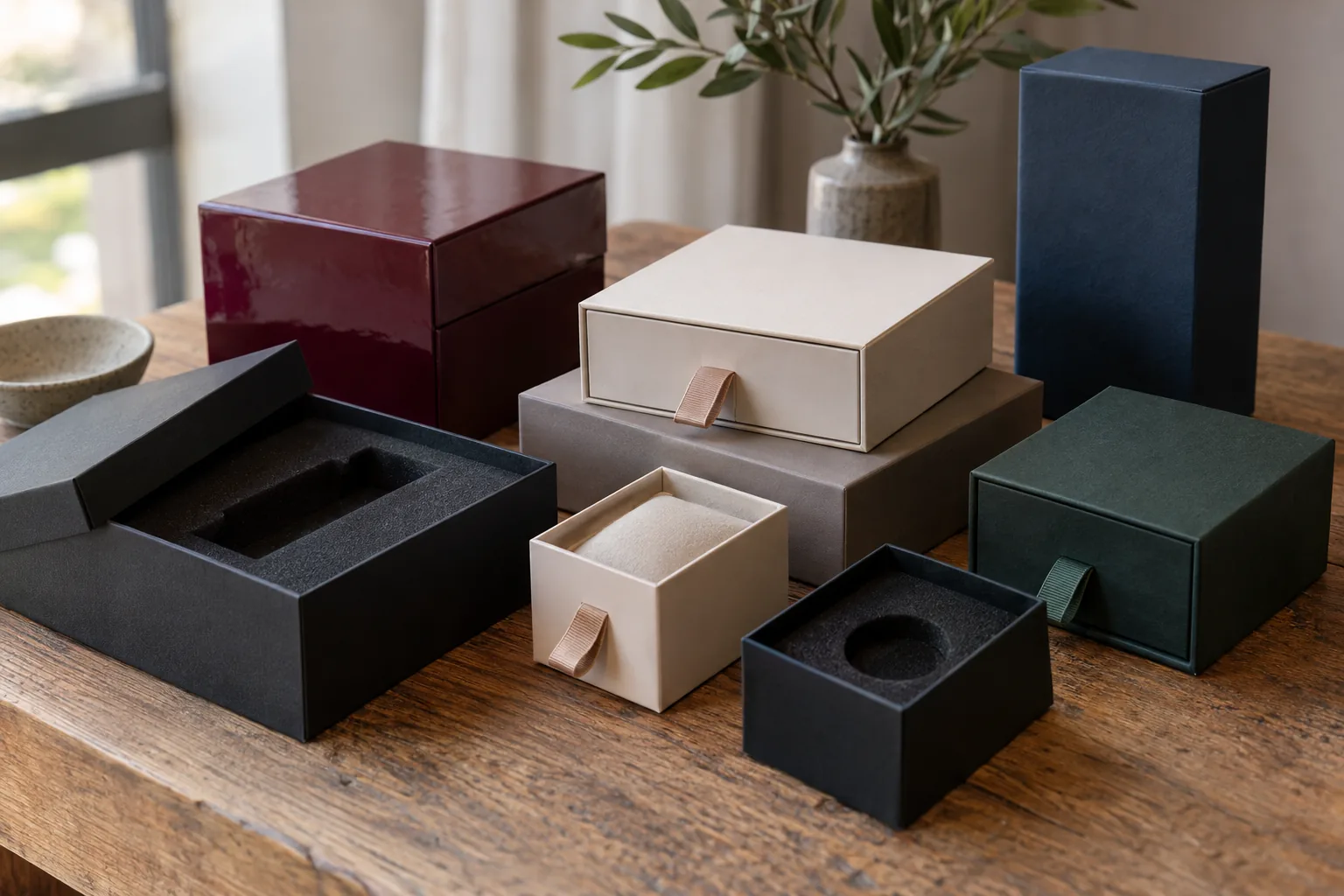
- Gift boxes. Rigid boxes with lids, drawer boxes, magnetic closures and folding gift boxes. They are the most requested type and the most variable in price, because the finish (foil, embossing, ribbon, inserts) drives the cost more than the size does.
- Mailer and shipping boxes. Corrugated boxes printed with your logo, used by online shops to send parcels. They ship flat, which keeps the freight low.
- Folding cartons. The retail box your product sits in on a shelf. Common for cosmetics, supplements, small electronics and food products, though what goes inside decides which Kenyan standards apply.
- Labels and stickers. Light, cheap to ship and easy to reorder. Paper labels have their own HS heading and, as the excise section below shows, their own excise line.
- Plastic bottles and containers. Possible, but plastic articles can carry excise of their own. A KRA public notice on excise duty lists 10% on articles of plastic under tariff headings 3923.30.00 and 3923.90.90, effective December 27, 2024, so check the code before you order.
If you already sell products that need protective packaging, our kitchen utensils import guide shows how breakage turns up in practice and why export cartons and inner padding matter as much as the box itself.
What Is the Packaging Import Duty in Kenya?
Packaging import duty depends on the HS code of the exact item, not on the word packaging. Paper cartons and boxes sit under heading 4819, paper labels under 4821 and plastic bottles under 3923, and each line carries the rate set in the EAC Common External Tariff, which uses four bands: 0%, 10%, 25% and 35%.
We do not print a rate for each line here, because the rate for your exact code is the one that counts and later EAC gazettes can change individual lines. The 2022 version of the EAC Common External Tariff on the KRA site is the schedule to check, and our HS codes Kenya guide shows how to look a code up. This table lists the headings that come up most often for packaging.
| Packaging item | HS code | What decides the code |
|---|---|---|
| Corrugated cartons, boxes and cases | 4819.10.00 | Corrugated paper or paperboard |
| Folding cartons and boxes, non-corrugated | 4819.20.90 | Folding construction, paper or paperboard |
| Skillets and free-hinge lid packets | 4819.20.10 | The specific carton style |
| Paper and paperboard labels | 4821.10.00, 4821.90.00 | Printed or not |
| Plastic bottles and similar containers | 3923.30.00 | Material and shape |
| Rigid gift boxes with lids | Confirm per product | Construction, lid, covering and material |
The last row matters most for gift boxes. A rigid box with a separate lid and a printed paper covering can classify differently from a folding carton, so we confirm the code from the supplier’s photos and material description before we quote anything. Classification follows what the item actually is, not what the supplier calls it.
On top of duty, VAT of 16% and the IDF and RDL apply to imports. Our Kenya import duty guide explains how they stack, and the import duty calculator lets you test a figure. If you ship with us, all of it is inside the all-in rate, so you do not receive a separate duty bill.
Does Excise Duty on Packaging Apply to Imports?
Excise duty on packaging applies to imported paper cartons and boxes, and the Finance Act 2025 changed how it is charged, so it belongs in any packaging budget. The KRA public notice on the Finance Act 2025 excise changes lists imported cartons, boxes and cases of corrugated paper, folding cartons of non-corrugated paper and similar packets at the higher of 25% or 200 ksh per kg, effective July 1, 2025. Before that date the rate was 25% of value alone.
The same notice sets paper, paperboard and labels under heading 4821 at the higher of 25% or 200 ksh per kg, up from 150 ksh per kg, and imported glass bottles at 35% or 40 ksh per kg, excluding pharmaceutical packaging and goods from EAC countries.
The weight-based floor is what catches importers out. Cartons are light and cheap per kilogram, so 25% of their value can be smaller than 200 ksh per kg, and then the per-kg figure sets the bill. On that wording, 100 kg of cartons carries at least 20,000 ksh of excise.
The rule has not stood still. In September 2025 the Agriculture Cabinet Secretary announced that taxes on packaging materials for agricultural exports would be removed, and we have not found a legal text that settles what applies to other importers today. We treat the KRA notice as the baseline and confirm the current excise position on every packaging shipment before we quote.
If you ship with Pamoja Imports, the all-in rate covers excise on paper cartons, so it never appears as a separate bill. If you import on your own, ask your clearing agent for the excise line before you pay the supplier, because it is calculated on top of the duty. Our Kenya customs clearance guide covers what a clearing agent charges and how the process runs.
Does Imported Packaging Need KEBS or PVoC Certification?
Assume yes unless KEBS confirms an exemption. Under the PVoC scheme, Intertek explains that products are in scope unless KEBS specifically exempts them, and a consignment that needs a certificate of conformity cannot clear customs without one.
We could not find a published list that names empty packaging, so we do not claim a particular box or carton is exempt or required. The practical step is to ask KEBS or a PVoC contractor about your exact product before you pay a supplier. If the packaging will touch food or hold a product that is itself regulated, ask about both the packaging and the product it carries.
For the wider picture on standards, documents and the IDF, see our guide to Kenya import regulations in 2026.
Should You Ship Packaging by Sea or Air?
Sea, almost always, because packaging is light for its size and freight follows volume. Our sea rate is 65,000 ksh per CBM with a minimum of 0.1 CBM, while air is 1,700 ksh per kg with a minimum of 1 kg, and air weight is volumetric: length times width times height in cm, divided by 6,000.
That divisor is why air is a poor fit for empty boxes. A carton measuring 60 x 40 x 40 cm is 96,000 cubic cm, which counts as 16 kg on air whatever it actually weighs, or 6,500 ksh at the 0.1 CBM minimum by sea. The table shows 500 gift boxes of 30 x 20 x 10 cm each, assembled and flat-packed, to make the point.
| Shipment of 500 gift boxes | Volume or weight | Freight at our rate | Per box |
|---|---|---|---|
| Assembled, by sea | 3 CBM | 195,000 ksh | 390 ksh |
| Flat-packed, by sea | 0.75 CBM (assumed) | 48,750 ksh | about 98 ksh |
| Assembled, by air (comparison only) | 500 kg volumetric | 850,000 ksh | 1,700 ksh |
| Flat-packed, by air (comparison only) | 125 kg volumetric | 212,500 ksh | 425 ksh |
This is a worked illustration, not a quote. The flat volume depends on the box design, and we assumed a quarter of the assembled volume. The figures are freight only: the products, the supplier’s price for the boxes and the last-mile delivery fee come on top, and duty, VAT, IDF, RDL and clearance are already inside the rate.
The lesson is to ask the supplier for a flat-packed price and quote the volume on that basis. For rigid boxes that cannot fold, the saving is smaller, and it is worth asking whether a folding design does the same job.
Sea freight takes 30 to 45 days from our China warehouse until the goods are cleared and ready at our Kenya warehouse, and air takes 7 to 14 days. Departures are usually once a week, with no fixed cutoff day. Our guide to how long shipping from China to Kenya takes covers the full timeline, and the sea freight vs air freight comparison covers when each mode wins. You can test your own numbers in our shipping calculator.
How Do You Order Custom Packaging From China?
Send the factory exact dimensions or a dieline, final artwork and a quantity, then approve a sample before the full run is printed. Custom packaging from China is made to order, so every step before production is cheaper to fix than anything after it.
- Measure the product, not the old box. Include padding and any insert. A box that is 5 mm too small cannot be fixed after printing.
- Choose material and finish. Ask for the paperboard or corrugated grade in writing, and for the finish (matt, gloss, foil, embossing) as a separate line, because each adds cost.
- Get the dieline. The factory supplies a flat template for your box size. Your designer places the artwork on it, in vector files with the colours set up for print.
- Approve a digital proof, then a physical sample. Colours on a screen rarely match a printed carton, so the sample is where you catch them. We order samples when the product warrants one.
- Confirm the quantity. Many factories set a minimum run for printed packaging. Check what the minimum is, and whether a larger run lowers the price enough to justify the storage space.
- Plan for the lead time. Preparation time varies by product and quantity, and there is no standard figure. Ask the factory for a date in writing and count it before the shipping time.
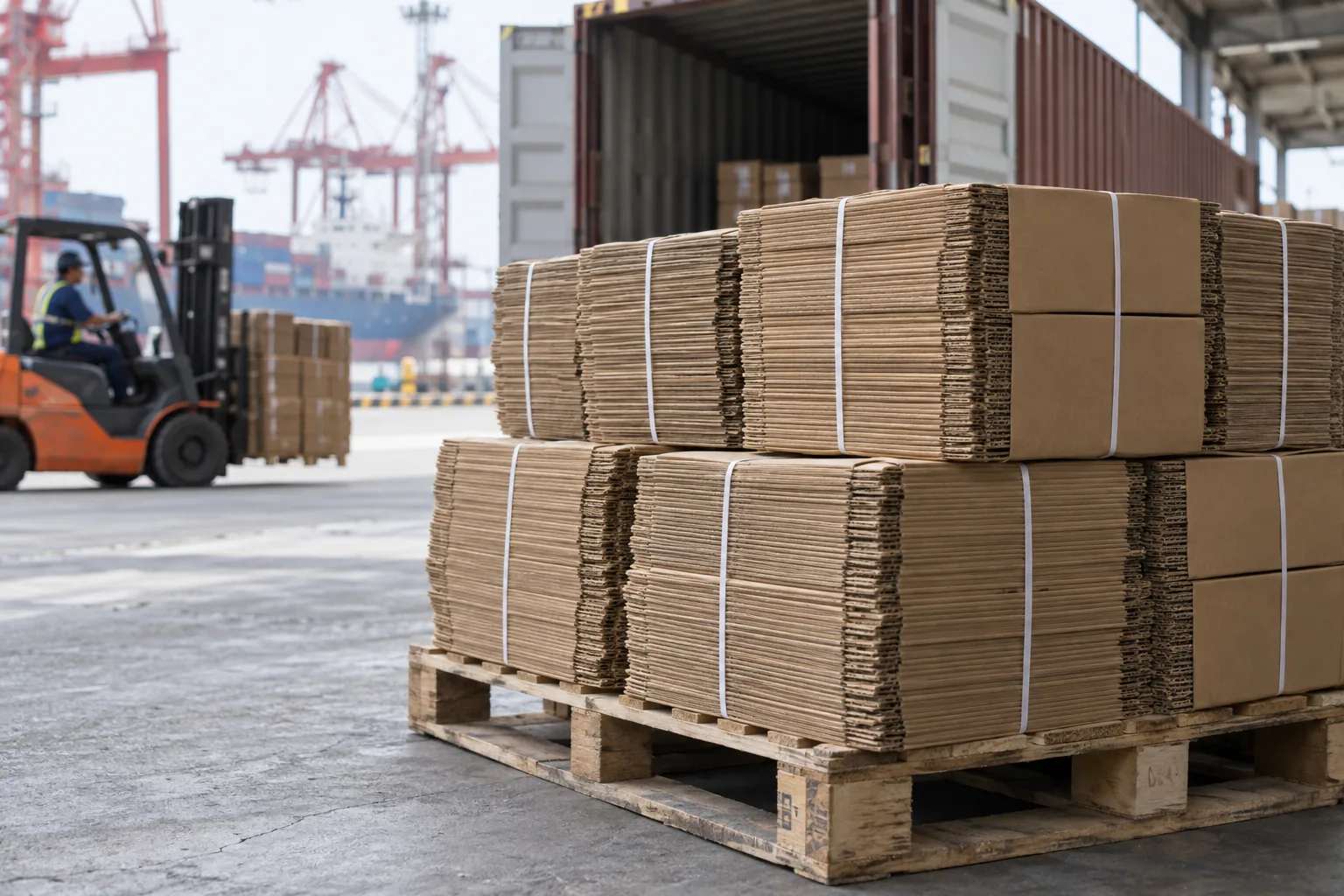
- Ship flat. Ask for the carton count, weight and size per carton, because the shipping quote is built from them.
Our Chengdu team handles this conversation with the factory in Mandarin, which removes a common source of mistakes in dieline and finish instructions. We do not curate or propose products, so you tell us the box you want, in photos, a link or a specification, and we find suppliers who make it. Our guide to negotiating with Chinese suppliers covers what to ask for on price, minimums and samples.
Pamoja Imports: from sample to Nairobi
We find factories that make the box you describe, negotiate through our Chengdu team and ship everything from our China warehouse under one all-in rate. You approve the product before we order.
- Sourcing through Pinduoduo and 1688 at domestic prices
- All-in rate covers duty, VAT, IDF, RDL, clearance and excise on paper cartons
- Track the shipment on our order tracking page
How Does Pamoja Imports Handle a Packaging Order?
To import packaging from China to Kenya with us, you send the request, we find suppliers and quote the product, and we ship the finished packaging from our China warehouse once you have approved it. Sourcing itself is free, and the minimum product order is 30,000 ksh, excluding shipping.
- Submit the request. Use the source request form with photos, a link or a specification, the sizes, the quantity and your artwork if you have it.
- We find suppliers and quote the product. The quote covers the product only. Shipping is quoted separately from the carton weight and size.
- You approve and pay. Once you approve, we place the order with the supplier.
- The supplier delivers to our China warehouse. Suppliers who hold stock usually reach the warehouse in 2 to 3 days. Made-to-order packaging takes longer, as described above.
- We ship and you track. Departures are usually once a week. The shipping balance is paid when the goods arrive at our Kenya warehouse, and the last-mile fee is paid on delivery.
If you already have a packaging supplier, you do not need sourcing. Message us on WhatsApp, ask your supplier to share the carton details and we quote the shipping. We send the shipping mark straight to your supplier, so you do not have to pass it on. Clients can also collect from our Nairobi warehouse in Industrial Area or our Mombasa warehouse in the CBD.

What Mistakes Cost Packaging Importers Money?
The costliest mistakes are shipping boxes assembled, skipping the sample and pricing the order without the excise line. All three are cheap to fix before the order is placed and expensive afterwards.
Import packaging from China to Kenya checklist
- Product measured with padding and inserts
- Material, finish and quantity confirmed in writing
- HS code confirmed for the exact box construction
- Excise position on paper cartons checked for the current month
- Dieline and final artwork approved
- Digital proof and physical sample approved
- Flat-packed carton count, weight and size received from the supplier
- Production date agreed before the shipping date is counted
Most of these mistakes also show up on other products, and our guide to the mistakes importers make when importing from China to Kenya lists the wider set. Once the boxes land, our guide to selling imported products in Kenya covers pricing them into your margin.
Pamoja Imports: one quote from factory to Kenya
Tell us the box you need and the quantity. We find the factories, you approve the product, and we ship it from our China warehouse under one all-in rate.
- Sourcing is free, with a 30,000 ksh minimum product order
- Air at 1,700 ksh per kg or sea at 65,000 ksh per CBM, all-in
- Clients can collect from our Nairobi or Mombasa warehouse
Frequently Asked Questions: Import Packaging From China to Kenya
For more answers to common questions about importing from China to Kenya, visit our Kenya import FAQ page.
Yes, but small runs of printed packaging cost more per box, because the factory still has to set up the print. For sourcing orders our minimum is 30,000 ksh of product, excluding shipping. If your order is smaller than that, send us the request anyway and we will tell you whether it can be done.
No. Our all-in rate covers duty, VAT, the IDF fee, the RDL and customs clearance, and it also covers excise on paper cartons. The rate is 65,000 ksh per CBM by sea (minimum 0.1 CBM) and 1,700 ksh per kg by air (minimum 1 kg). A last-mile delivery fee is separate if you want us to deliver from our Kenya warehouse.
It depends on how the box is made. Folding cartons of paper or paperboard usually sit under heading 4819, but rigid boxes with a lid and a covering can classify differently. Send us the supplier’s product photos and material description and we will confirm the code before we quote.
Sea freight takes 30 to 45 days from our China warehouse until the goods are cleared and ready at our Kenya warehouse. Printed packaging is made to order, so production time comes on top and varies with the product and quantity. Stock designs from a supplier that already has them reach our China warehouse faster.
Yes. Factories print custom designs on boxes, cartons and labels, and the usual process is a dieline, final artwork, a digital proof and then a physical sample before the full run. We recommend approving the sample before production starts, because print colours rarely match a screen exactly.
Flat, whenever the design allows it. Freight is charged on volume, and assembled boxes carry a lot of empty space. In our worked example, 500 gift boxes cost about 390 ksh each to ship assembled by sea and about 98 ksh each flat-packed, using a flat volume we assumed at a quarter of the assembled volume.
Need packaging for your products? We will find the factory
Send us the box you need, or share your supplier’s details. We handle the sourcing, freight and clearance to our Kenya warehouse.
Need Sourcing? I Have a Supplier
Jonatan Sirak sirak.se
Founder of Pamoja Imports, a Kenya-China import agency with an operations team based in Chengdu, China. Based in China since 2018, he studied Mandarin and built direct factory relationships in Chengdu, and now helps Kenyan entrepreneurs source and import products profitably. He splits his time between Nairobi and Chengdu.