
Kenya Import Regulations 2026: PVoC, IDF, KRA Clearance and What Changed This Year

If you are new to importing and want to understand the full process before diving into compliance, start with our How to Start an Import Business in Kenya in 2026 guide. Kenya import regulations 2026 require every importer to have an Import Declaration Form (IDF), a Certificate of Conformity (CoC) from a KEBS-approved PVoC agent for regulated goods, a commercial invoice, a packing list, and a Bill of Lading or Airway Bill.
Five significant changes affect importers this year: PVoC contracts for general goods were reset in February 2026, the Railway Development Levy increased to 2% in December 2024, mandatory radiation screening of all cargo at Kenyan ports took effect from 1 May 2026, the Advance Cargo Declaration became mandatory for sea cargo from 3 August 2026, and the consolidated cargo customs benchmark is being renegotiated following trader protests in August and September. This guide covers what each requirement means in practice and what you actually need to do before your goods leave China.
Kenya import regulations 2026 are the part of importing most first-time importers underestimate. Duties are visible and calculable upfront. Compliance failures are invisible until your goods are stuck at Mombasa and demurrage starts accumulating. A shipment rejected for missing documentation costs you the goods, the duties already paid, and the relationship with your buyer.
Last verified: September 13, 2026
This guide is written specifically for Kenyan entrepreneurs importing from China. It covers the current requirements as of September 2026, including the PVoC reset in February, the new Advance Cargo Declaration requirement from August, and the consolidated cargo benchmark dispute still being resolved. For the cost side of importing, see our Kenya import duty from China guide. For the full import process, see our complete guide on how to import from China to Kenya.
What Documents Do You Need to Import Into Kenya in 2026?
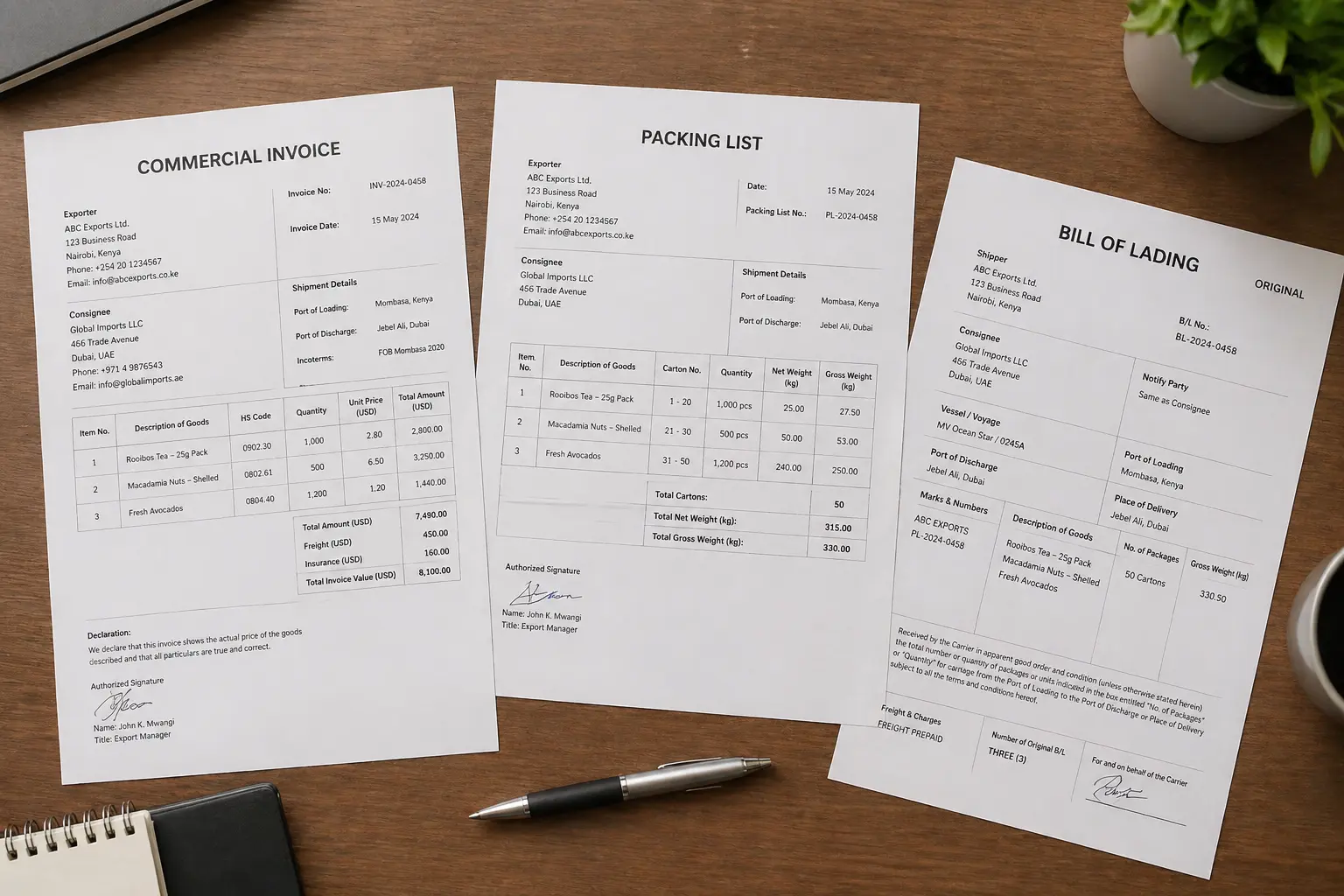
KRA requires the following documents for every commercial import into Kenya, regardless of product type or origin. Missing any one of these at the time your goods arrive at the port triggers delays, detention fees, and in some cases, rejection of the entire shipment.
- Import Declaration Form (IDF). Filed electronically through the KRA iCMS portal before your goods arrive. The IDF number must be obtained and paid before clearance can begin. The IDF fee is 2.5% of the CIF value of your goods, set under the Miscellaneous Fees and Levies Act as amended by the Finance Act 2023. See our IDF in shipping Kenya guide for the full breakdown.
- Commercial Invoice. Issued by your Chinese supplier. Must include the supplier’s full company name and address, a detailed product description with HS code, unit price, total value, currency, and Incoterms. KRA uses this to assess duty. An incomplete or inconsistent invoice will trigger reassessment.
- Packing List. Must match the commercial invoice exactly in terms of quantities, descriptions, and weights. Any discrepancy between the packing list and the physical shipment is a red flag at customs.
- Bill of Lading (sea freight) or Airway Bill (air freight) For a cost and time comparison of both methods, see our Sea Freight vs Air Freight China Kenya 2026: Cost and Time Compared guide.. Issued by the shipping line or airline. This is the title document for your goods. Original Bill of Lading required for sea shipments.
- Certificate of Conformity (CoC). Required for all goods covered under the KEBS PVoC programme. Issued by a KEBS-approved inspection agent in China before shipment. Not required for all goods, but the list of regulated products is broad. See the PVoC section below for the current situation.
- Sector-specific certificates. Required depending on product type. Agricultural inputs require a KEPHIS import permit. Pharmaceuticals require PPB approval. Food products require KEBS certification. Confirm your specific requirements before ordering.
What Is PVoC and What Changed in 2026?
The Pre-Export Verification of Conformity (PVoC) programme is Kenya’s system for ensuring that imported goods meet Kenya Standards before they leave the exporting country. KEBS contracts third-party inspection companies to inspect and certify goods in China before shipment. If your goods pass inspection, the inspection agent issues a Certificate of Conformity (CoC), which you need for clearance at Mombasa or JKIA.
Which goods require PVoC?
PVoC applies to a wide range of imported products including electronics and electrical equipment, clothing and textiles, construction materials, cosmetics and personal care products, food products, and many household goods. Raw materials imported by registered local manufacturers, goods certified under the KEBS Diamond Mark scheme, and goods imported for national projects with a government waiver are exempt.
Goods with a customs value below USD 100 that are for personal use are also exempt from PVoC, though this exemption does not apply to used motor vehicles, used spare parts, or used clothing.
What changed in February 2026
The practical implication for importers: if your goods were shipped between 9 and 18 February 2026 without a valid CoC, they would have been subject to the 0.6% destination inspection fee. If you are shipping now, the normal PVoC process applies and you should obtain your CoC from one of the currently contracted inspection agents before shipment.
How to get a CoC for your China shipment
- Share the applicable Kenya Standards with your Chinese supplier so they know what specifications the goods must meet
- Arrange for a KEBS-contracted inspection agent to inspect and test the goods in China before shipment. SGS is one of the contracted agents covering China under the new 2026-2029 cycle
- The inspection agent issues the CoC if the goods pass. The CoC must be submitted to both KEBS and KRA through the National Single Window system before goods can be released at the port
- If goods do not pass inspection, a Non-Conformity Report (NCR) is issued. Goods with an NCR cannot be shipped to Kenya
Solar panels are one of the most complex products to navigate through PVoC because a typical solar system shipment contains both PVoC-regulated items (panels, inverters, batteries) and exempt components, each requiring a separate CoC. For a product-specific breakdown of the CoC process and what the dual-IDF requirement means in practice, see our guide on how to import solar panels from China to Kenya.
How Does KRA Customs Clearance Work?
You cannot clear goods at Mombasa or JKIA without a KRA-licensed clearing agent. This is a legal requirement, not an optional service. The clearing agent declares your goods through the KRA iCMS customs portal and manages the customs assessment and payment process on your behalf.
The clearance process step by step
- IDF filing. Your clearing agent files the Import Declaration Form on iCMS before your goods arrive. The IDF number must be included on all subsequent customs documents.
- Goods arrival. Your shipment arrives at Mombasa Port or JKIA. The shipping line or airline notifies your clearing agent.
- Customs entry. Your clearing agent lodges a customs entry (declaration) on iCMS with all supporting documents: commercial invoice, packing list, Bill of Lading or Airway Bill, CoC where required, and any sector-specific certificates.
- Assessment. KRA assesses the duty payable based on the declared CIF value and applicable HS code. If KRA suspects undervaluation, they will reassess using their reference value database. Penalties for undervaluation can exceed the original duty amount.
- Duty payment. Import duty, VAT, IDF, and RDL are paid through the KRA portal. With Pamoja, this is handled as part of our all-in rate.
- Release. Once duties are paid and all documentation is in order, KRA releases the goods. Physical inspection may be conducted before release depending on the goods category and risk profile.
What Goods Are Prohibited or Restricted From China?
Some goods cannot be imported into Kenya at all. Others can be imported but require special permits obtained before shipment. Getting this wrong means your goods are seized at the border with no refund on duties paid.
Prohibited goods
- Counterfeit goods. Goods bearing fake trademarks or unauthorised brand identifiers. KRA and KEBS actively screen for counterfeit products. A shipment of fake branded goods will be seized and destroyed.
- Pornographic material. All forms, including digital media.
- Illegal drugs and narcotics. No exceptions.
- Goods bearing unauthorised use of a partner state’s coat of arms or official insignia.
- Matches manufactured with white phosphorus.
Restricted goods requiring permits
- Pharmaceuticals and supplements. Require Pharmacy and Poisons Board (PPB) approval before importation. The PPB registration process is lengthy. Not suitable for first-time importers.
- Agricultural inputs. Seeds, fertilisers, and pesticides require a Kenya Plant Health Inspectorate Service (KEPHIS) import permit.
- Food products. Require KEBS certification and in some cases Kenya Food and Drugs Authority (KFDA) clearance.
- Firearms and ammunition. Require prior written approval from the Inspector General of Police.
- Radioactive materials. Require a valid KNRA Import License. From 1 May 2026, all cargo at Kenyan ports is screened for radioactive materials. See the section below on the new KNRA directive.
What Changed in Kenya Import Regulations 2026 This Year?
Several changes to Kenya import regulations 2026 have come into effect in the past 12 months that directly affect Kenya importers sourcing from China. Some were anticipated, others caught importers off guard.
Consolidated cargo customs benchmark cut after trader protests
KRA raised the minimum customs benchmark for general consolidated cargo from 2.5 million ksh to 3.2 million ksh from 20 August 2026, prompting protests from small traders whose shared-container shipments were valued well above their actual cost. Following a 2 September 2026 meeting between President Ruto and trader representatives, the government agreed to cut the benchmark further, to 2 million ksh. Implementation is pending a KRA-published list of high-value goods that will be excluded from the consolidated arrangement and assessed separately. If you ship LCL or consolidated cargo, confirm the benchmark actually in force with your consolidator before committing to a shipment, since this is still being finalised at the time of writing.
Advance Cargo Declaration (ACD) now mandatory for sea cargo
From 3 August 2026, KRA requires a valid Advance Cargo Declaration reference for all containerised sea cargo bound for Kenyan ports, obtained before loading and endorsed on the Bill of Lading. From 1 September 2026, carriers must validate the ACD reference before loading, and a container without one risks being rolled to a later vessel. This applies to sea freight only, not air freight. For the full requirements and how to obtain your reference code, see our Advance Cargo Declaration Kenya guide.
KNRA mandatory radiation screening of all cargo
From 1 May 2026, the Kenya Nuclear Regulatory Authority (KNRA) requires all containerised cargo entering or exiting Kenya to pass through radiation detection monitors at strategic points including Mombasa Port and Inland Container Depots. The screening is non-intrusive and uses gamma and neutron radiation detection. For standard China imports such as electronics, clothing, household goods, and construction materials, this change has no practical impact. Importers of any goods containing radioactive sources must hold a valid KNRA Import License and ensure correct HS code documentation.
PVoC contracts reset, new three-year cycle begins
The previous PVoC contracts for general goods expired 8 February 2026. New three-year contracts were awarded to nine inspection companies effective 19 February 2026, covering the 2026-2029 cycle. Shipments without a valid CoC during the transition window (9-18 February) were subject to a 0.6% destination inspection fee. The normal PVoC process is now fully operational. Importers should confirm their inspection agent is contracted under the new cycle before booking an inspection.
Railway Development Levy increased to 2%
The RDL was increased from 1.5% to 2% of CIF value under the Tax Laws (Amendment) Act 2024, effective 27 December 2024. Many online calculators and articles still show the old 1.5% rate. If your landed cost calculations use the old figure, your numbers are wrong. For a full breakdown of the levy, see our Railway Development Levy Kenya guide.
Mobile phone import duty: 25%, not 35%
Mobile phones attract a 25% import duty, not the 35% previously stated on this page. Kenya applied a one-year stay on the EAC Common External Tariff’s 0% rate for tariff lines 8517.13.00 and 8517.14.00, charging 25% instead, in effect since 1 July 2024 and confirmed current for 2026 by PwC’s Kenya tax summary. Phones also attract 10% excise duty on top. This page previously cited “EAC Gazette Notice No. 19 of 2025” for a 35% rate; that figure was incorrect and has been corrected here. For the full cost breakdown on importing phones, see our guide on importing phones from China to Kenya.
IDF reduced to 2.5%
The Import Declaration Fee was reduced from 3.5% to 2.5% of the CIF value under the Miscellaneous Fees and Levies Act. This reduction remains in effect in 2026. Many older sources still quote the 3.5% rate. Use 2.5% in all your landed cost calculations. For a full breakdown of how IDF works, how to calculate it, exemptions, and what happens if it is not filed before your goods arrive, see our IDF in shipping Kenya guide.
Every shipment is fully compliant before it leaves China.
Our Chengdu team verifies the correct HS code for your goods, confirms PVoC requirements before you place your order, and coordinates CoC certification where required. On the Kenya side, our all-in shipping rate includes customs clearance handled by a KRA-licensed agent. For the full step-by-step customs clearance process at Mombasa and JKIA, see our Kenya Customs Clearance for China Imports: Step-by-Step Guide 2026. You do not file the IDF separately, you do not hire a clearing agent separately, and you do not get surprise duty bills at the port.
- HS code verification before every order
- PVoC requirements confirmed for your specific product
- CoC coordination with our China team where required
- IDF filing and customs clearance included in our all-in rate
- All duties, VAT, IDF, and RDL absorbed into one transparent price
Frequently Asked Questions
For more answers to common questions about importing from China to Kenya, visit our Kenya import FAQ page.
Every Kenya import requires an Import Declaration Form (IDF) filed via KRA iCMS, a Certificate of Conformity (CoC) from a KEBS-approved PVoC agent for regulated goods, a Commercial Invoice, a Packing List, and a Bill of Lading (sea) or Airway Bill (air). Sector-specific certificates such as KEPHIS approval for agricultural goods or PPB approval for pharmaceuticals are required where applicable.
The previous PVoC contracts for general goods expired on 8 February 2026. During a brief transition period, goods shipped without a valid Certificate of Conformity were subject to Destination Inspection at 0.6% of customs value. KEBS awarded new three-year contracts to nine inspection companies effective 19 February 2026. PVoC services for general goods from China are now fully operational under the new 2026-2029 cycle.
Yes. KRA requires all imports to be declared through a KRA-licensed clearing agent using the iCMS customs portal. You cannot self-clear goods at Mombasa or JKIA without a licensed agent. Pamoja handles customs clearance as part of our all-in shipping rate, so there is no need to hire a separate clearing agent.
Prohibited imports include counterfeit goods and goods bearing fake trademarks, pornographic material, illegal drugs and narcotics, and goods bearing unauthorised use of a partner state’s coat of arms. Restricted goods requiring special permits include pharmaceuticals (PPB approval), agricultural inputs (KEPHIS permit), firearms (police permit), and certain food products (KEBS certification).
From 1 May 2026, the Kenya Nuclear Regulatory Authority requires all containerised cargo entering or exiting Kenya to undergo mandatory radiation screening at Mombasa Port and Inland Container Depots. For most standard China imports this has no practical impact. Importers of any items containing radioactive sources must hold a valid KNRA Import License.
The IDF is 2.5% of the CIF customs value of your goods, reduced from 3.5% by the Finance Act 2023. This rate remains in effect in 2026. The IDF must be paid before your goods can be cleared at the port. With Pamoja, IDF is included in our all-in shipping rate.
Yes, if your shipment is containerised sea cargo. KRA’s Advance Cargo Declaration has been mandatory since 3 August 2026: a reference code must be obtained before loading and endorsed on the Bill of Lading. From 1 September 2026, carriers must validate the ACD reference before loading, and containers without one risk being rolled to a later vessel. The ACD requirement does not apply to air freight.
The consolidated cargo benchmark is the minimum reference value KRA uses to assess customs value on a general consolidated 40-foot container. It stood at 2.5 million ksh for around six years before KRA raised it to 3.2 million ksh from 20 August 2026. Following trader protests, the government agreed on 2 September 2026 to lower it to 2 million ksh, with implementation pending a KRA-published list of high-value goods excluded from the consolidated arrangement. Confirm the benchmark actually in force with your consolidator before shipping.
Not sure if your product is compliant? Ask us.
Send us a WhatsApp with your product and we will confirm the PVoC requirements, HS code, and full compliance checklist before you place your order.
Chat with us on WhatsApp
Jonatan Sirak sirak.se
Founder of Pamoja Imports, a Kenya-China import agency with an operations team based in Chengdu, China. Based in China since 2018, he studied Mandarin and built direct factory relationships in Chengdu, and now helps Kenyan entrepreneurs source and import products profitably. He splits his time between Nairobi and Chengdu.