

Shipping Mark China to Kenya: 5 Lines That Save Your Cargo
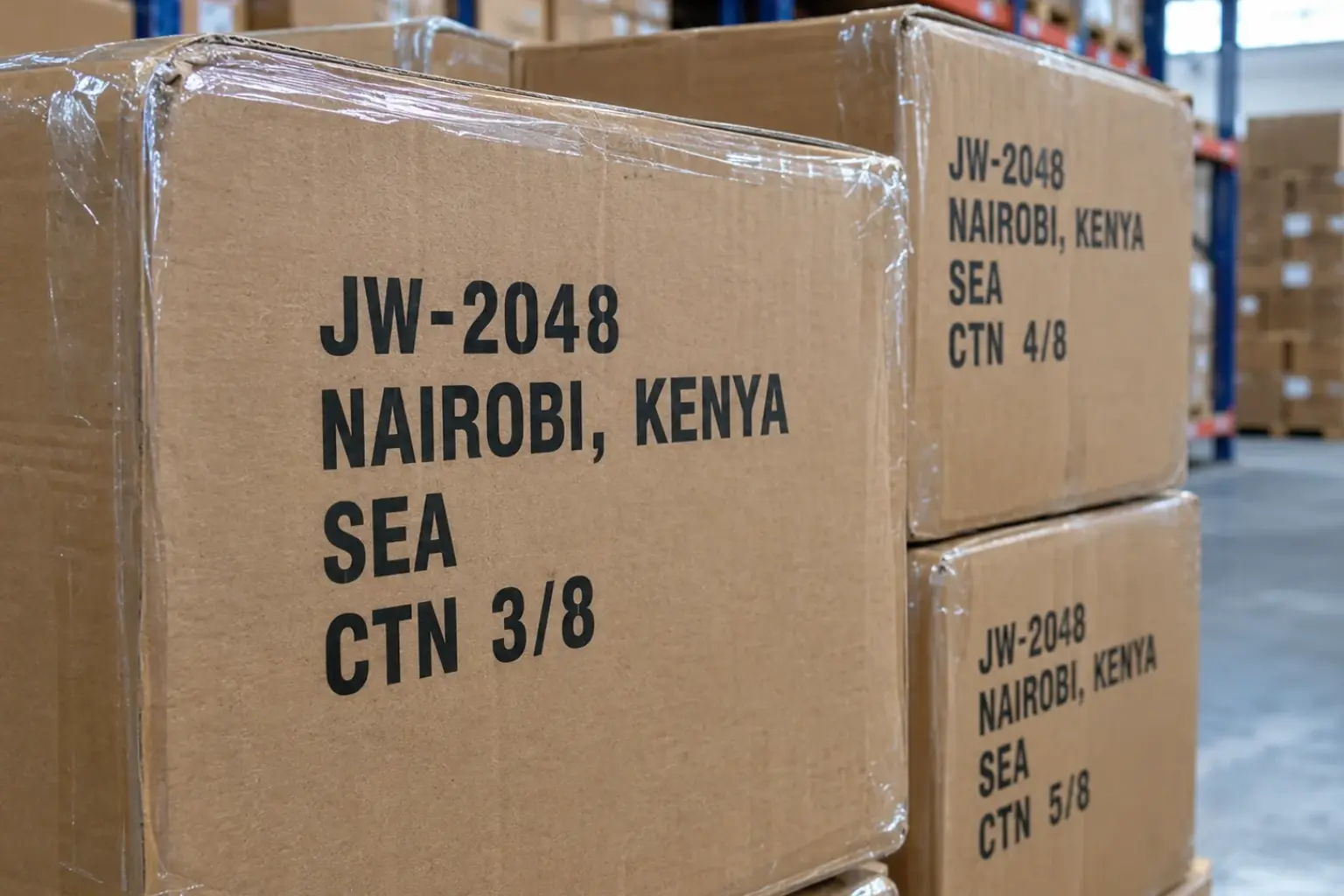
Shipping mark China to Kenya, in short: a shipping mark is the text on every carton that tells the warehouse in China whose goods they are, where they are going and how they will travel. On a shipping-only order with Pamoja Imports, we send the mark straight to your supplier, not to you, so it reaches the person packing your cartons without being passed along. Goods that arrive without the correct mark cannot be matched to your order and are returned to the supplier.
- What Is a Shipping Mark on Goods From China to Kenya?
- Why Does a China Warehouse Need Your Shipping Mark?
- What Goes on a Shipping Mark for China to Kenya Cargo?
- What Does a Shipping Mark Example Look Like?
- Who Puts the Shipping Mark on the Cartons?
- What Happens if Your Supplier Ships Without the Shipping Mark?
- How Is a Shipping Mark Different From Other Carton Marking?
- How Does the Shipping Mark Step Work With Pamoja Imports?
- Which Shipping Mark Mistakes Delay Kenya Shipments?
- Frequently Asked Questions: Shipping Mark China to Kenya
What Is a Shipping Mark on Goods From China to Kenya?
A shipping mark is a short block of text on the outside of each carton that identifies who owns the goods, where they are going and which shipment they belong to. The shipping mark meaning is simple: these boxes belong to this client and travel on this route, written so that anyone handling the carton can read it in a few seconds.
To see how it works in practice, picture the last few metres of your supplier’s packing line. The goods go into cartons, the cartons get sealed, and before they leave the factory gate someone writes or prints the mark on the side.
From that moment until the cartons are loaded for Kenya, the mark is the only thing that connects those boxes to you. There is no app, no barcode scan from your phone and no invoice taped inside that the warehouse will open to check. A supplier can pack your order perfectly and still stall it if the mark on the boxes is wrong or missing.
It is also different from the paperwork side of an import. Documents such as the commercial invoice and packing list travel with the shipment and matter when the goods are cleared in Kenya, which we cover in our Kenya customs clearance guide. The shipping mark works earlier, on the China side, when your cartons arrive at the warehouse alongside cartons from many other suppliers and clients.
Why Does a China Warehouse Need Your Shipping Mark?
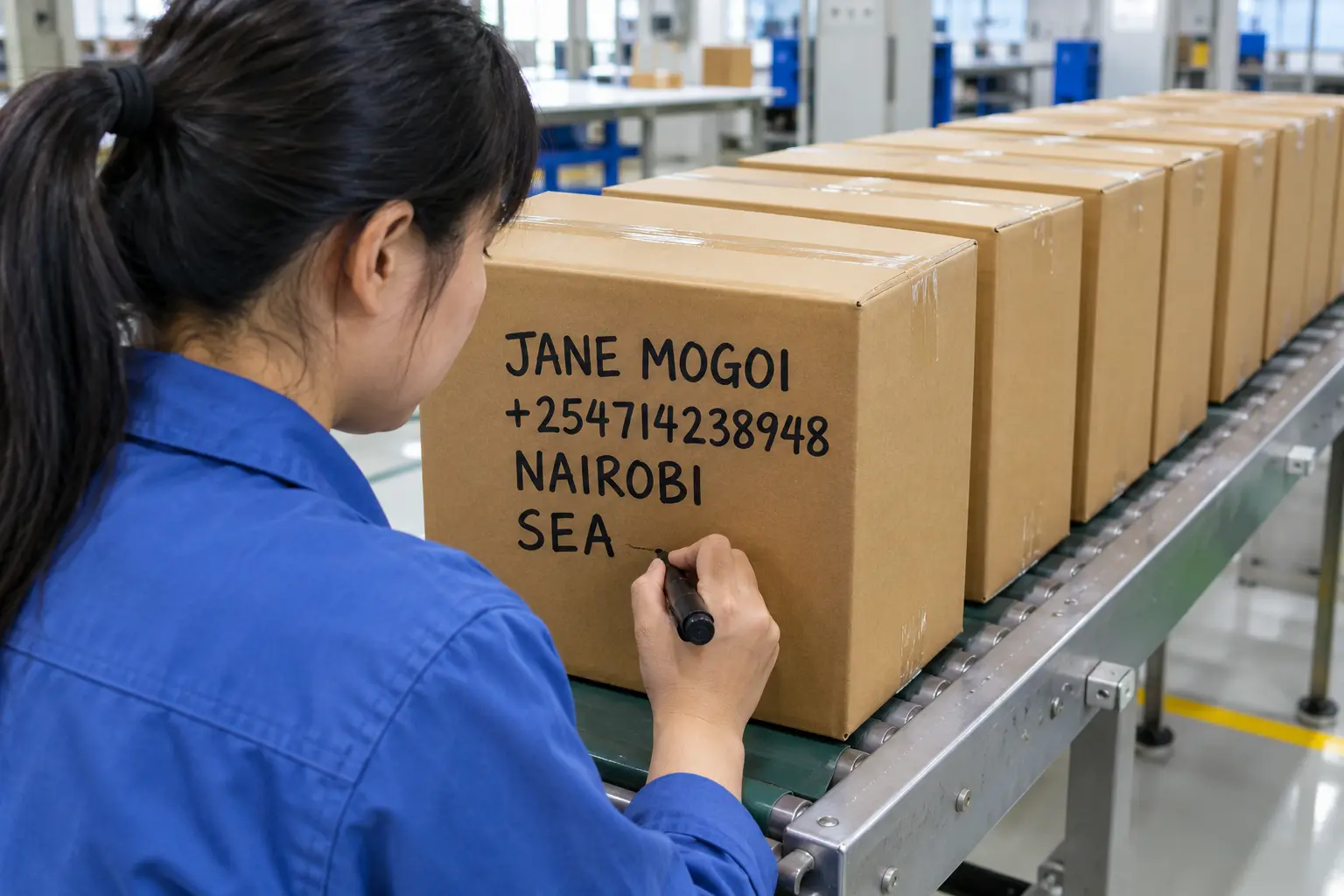
A China warehouse needs your shipping mark because it receives cartons from many different suppliers for many different clients, and the mark is how staff decide which shipment each carton joins. Without it, the warehouse has a sealed box with no reliable way to know who it belongs to.
Most of our clients do not fill a container on their own. A typical order is a few cartons, sometimes from two or three different suppliers, and those cartons are combined with goods from other clients into one air or sea shipment. If your own order comes from several suppliers, our guide to consolidated shipping from China to Kenya explains how we group it. This is what makes small orders affordable: you pay for your share of the space rather than for a whole container. Our sea freight vs air freight China Kenya guide explains how that space is charged by CBM for sea and by kg for air.
The trade-off is that your cartons sit next to everyone else’s, often in the same plain brown boxes and delivered by the same domestic courier. Staff match each carton to a client and a route, weigh and measure it, then group it with the rest of that client’s goods.
When the shipping mark is right, that matching takes seconds. When it is missing, the warehouse is left guessing, and a wrong guess can put your goods on someone else’s shipment, which is why unmarked goods are treated as a problem rather than sorted out later.
What Goes on a Shipping Mark for China to Kenya Cargo?
A shipping mark for China to Kenya cargo usually carries five things: a client name or code, the destination city, the shipping method, a short description of the goods and a carton number. The exact format depends on the forwarder and the route, which is why we send it to your supplier ourselves and ask them to copy it word for word.
| Part of the mark | What it tells the warehouse | Common mistake |
|---|---|---|
| Client name or code | Which client the carton belongs to | Supplier writes their own company name instead |
| Destination city | Where the goods are going, such as Nairobi | Left off, or the supplier writes “Africa” |
| Shipping method | Whether the carton joins an air or a sea shipment | Air mark used on goods meant for sea, or the reverse |
| Goods description | A short line on what is inside, sometimes in Chinese as well as English | Missing, so the warehouse cannot check it against the order |
| Carton number | Which carton this is out of the total, such as 3/8 | Every carton numbered “1”, so a missing box is not noticed |
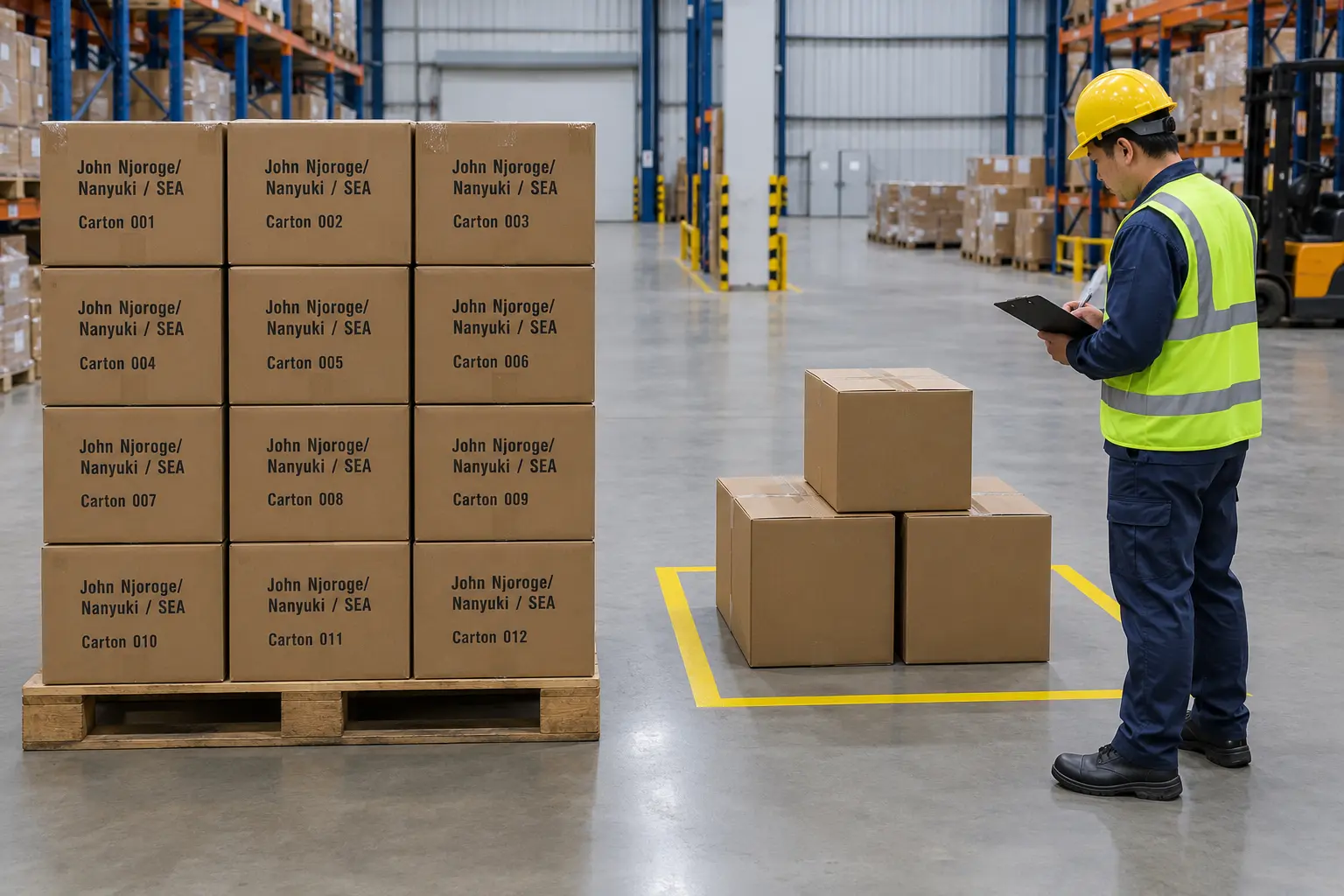
The carton number deserves extra attention. Writing “3/8” on the third of eight cartons means the warehouse can tell straight away if one has gone missing between the factory and the warehouse door. If every carton just says “1”, eight cartons and seven cartons look the same until you are counting boxes in Nairobi.
Some marks also include a Chinese line, because the people receiving goods at the warehouse read Chinese first. If the mark we send your supplier has Chinese characters in it, they are part of the mark, and the supplier should copy them as they are rather than dropping them or translating them into English.
What Does a Shipping Mark Example Look Like?
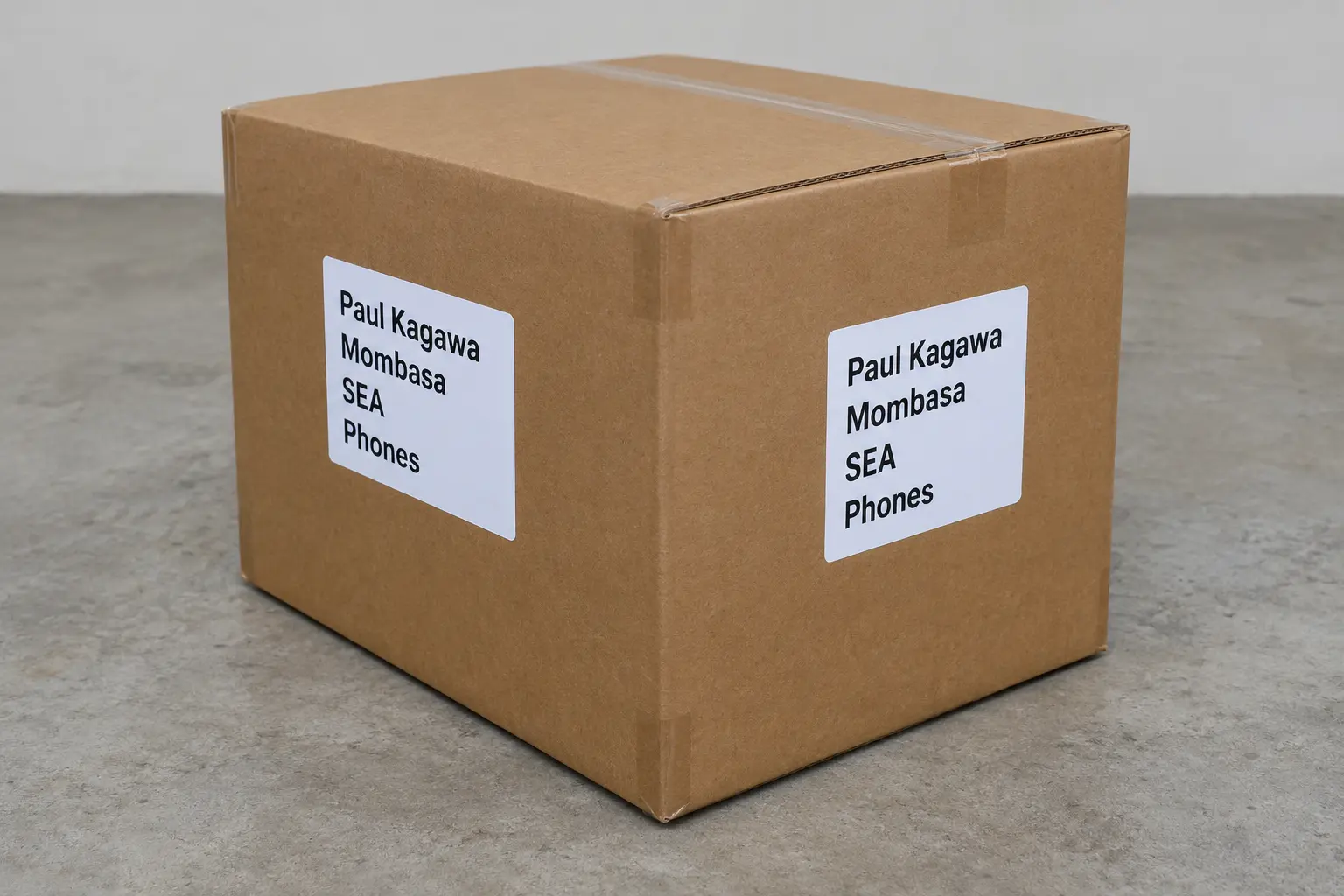
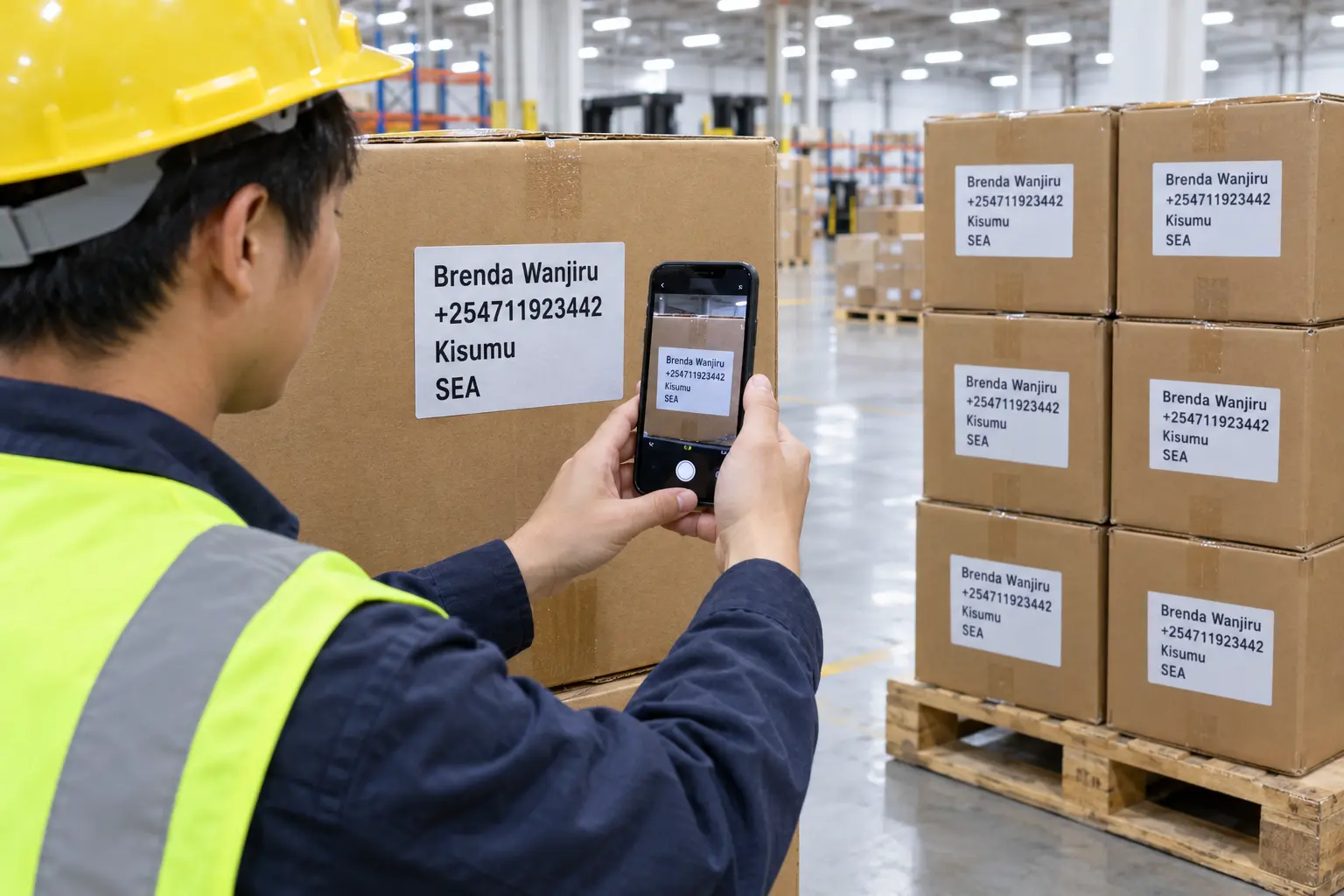
A shipping mark example for a small Nairobi order is five short lines on the side of every carton: the client name or code, the destination city, air or sea, a short goods description and a carton number such as 3/8. The sample below shows that layout, with made-up values.
Shipping mark China to Kenya example for illustration only. All names and codes are invented, and the real mark is sent to your supplier for each order.
Notice what is missing. There is no supplier logo, no marketing text and no long address. The mark is not the place for the supplier’s branding, and a crowded carton makes the important lines harder to read.
Some suppliers print the mark on a sticker, others write it with a thick marker pen. Either works, as long as it is readable and stays on the carton through handling and weather. This shipping mark example is also the layout we check against when your supplier sends us a photo of the packed cartons.
Where on the carton should the mark go?
The mark should be on at least two sides of each carton, not just the top. Cartons get stacked, and the top of one box is usually hidden under another. A mark on the side is visible while the cartons sit on a pallet or in a row on the warehouse floor. Stickers belong on a flat panel, away from seams and tape, so they do not tear when the box is opened for inspection.
Who Puts the Shipping Mark on the Cartons?
The supplier puts the shipping mark on the cartons, before the goods leave their premises. The forwarder provides the mark and the warehouse address, but only the supplier handles your cartons before they arrive at the warehouse, so only the supplier can label them.
That split of responsibility is where most problems start. The forwarder knows exactly what the mark should say, and the supplier is the one holding the marker pen. If the information gets lost between the two, nobody notices until the cartons arrive. Carton marking is a small job at the factory, but it is the one step in the chain that nobody else can do for the supplier.
This is why we send the mark and the warehouse details straight to your supplier and never route them through you. Every extra hand-off is a chance for a character to be dropped, a line to be shortened or an old mark to be forwarded by mistake. Sending it directly also means the supplier can ask us if anything is unclear, instead of guessing or waiting for a reply to travel through a third person.
Shipping-only orders
On a shipping-only order, you have found the supplier yourself, whether on a B2B marketplace, through a trade contact or from a previous order. Here the shipping mark is essential, because we are receiving goods from a supplier we did not choose and have not worked with before. Our ship from China to Kenya guide explains what a shipping-only order includes and what the all-in rate covers.
Sourcing orders
On a sourcing order, we find and buy from the supplier on your behalf and communicate with them directly, so the marking is handled on our side. You do not need to send a mark to anyone. If you are still at the stage of looking for a supplier, our guide on how to find Chinese suppliers covers the vetting steps.
What Happens if Your Supplier Ships Without the Shipping Mark?
If your supplier ships without the correct shipping mark, the goods cannot be matched to your order and are returned to the supplier. Any extra costs the supplier charges for that return or for sending the goods again may be added to your bill, and your shipment misses the departure it was planned for.
The cost of a missing mark is rarely just one fee. It usually arrives as a chain:
- The cartons are not accepted as yours. The warehouse cannot confirm the owner, so the goods are not added to your shipment.
- The goods go back to the supplier. The supplier may charge for the return trip, for re-labelling or for sending the cartons a second time.
- Your departure is missed. Air and sea shipments usually leave our China warehouse once a week, as soon as there is enough cargo, so a few days lost on the China side can push your arrival back by a week or more. Our guide on how long shipping from China to Kenya takes shows how one missed departure moves the whole timeline.
- Your selling window shrinks. If you were stocking up for a season, such as the January school term or the December holidays, late stock can mean selling at a discount or not selling at all.
Together, these steps turn a missing line of text into lost days and lost margin. Our 10 mistakes importing from China to Kenya guide shows how small coordination errors like this add up across a whole order, and our cash flow guide explains why a delay hurts even when no extra fee is charged.
Pamoja Imports: We send the mark to your supplier directly
On shipping-only orders we coordinate with your supplier ourselves, so the shipping mark and warehouse details reach the person packing your cartons instead of being passed along through you.
How Is a Shipping Mark Different From Other Carton Marking?
A shipping mark identifies who the goods belong to, while other carton marking tells people how to handle the box or warns them about what is inside. Both can appear on the same carton, but they do different jobs, and one does not replace the other.
Carton marking usually falls into three groups:
- The shipping mark. Client, destination, method, goods and carton number. This is what the warehouse uses to sort your cartons, and it is the part we send to your supplier.
- Handling symbols. Small pictures such as an umbrella for “keep dry”, a wine glass for “fragile” or arrows for “this way up”. These symbols are set out in the international standard ISO 780 on graphical symbols for handling and storage of packages, which is why they look the same on cartons from almost any country.
- Hazard markings. Goods such as some batteries, liquids and chemicals follow separate dangerous goods rules, which the ISO 780 standard does not cover. If your order might include anything like this, tell us before the supplier packs.
Handling symbols are useful for fragile goods such as glassware, ceramics or screens, and it is worth asking your supplier to add them. They do not tell the warehouse who owns the carton, so a box with every handling symbol can still be rejected if the shipping mark is missing.
A shipping mark is also not the same as a courier label. A domestic courier in China adds its own tracking label to tell its drivers where to deliver the box, but that label does not tell the warehouse whose box it is, so the shipping mark still has to be on the carton.
How Does the Shipping Mark Step Work With Pamoja Imports?
With Pamoja Imports, the shipping mark step happens after you pay the shipping deposit: we release the warehouse address and shipping mark to your supplier, the supplier labels every carton and delivers to the warehouse, and we match the cartons to your order when they arrive. Here is how a shipping-only order runs from your first message to tracking.
Tell the supplier you have a freight forwarder
Let your supplier know that you will use your own forwarder and share our WhatsApp number so they can speak to us directly. This is where the coordination starts.
We collect the package details and quote you
We contact the supplier for the number of cartons, weight and dimensions, and quote you from that real package information. You can check the figures yourself with our shipping calculator.
Pay the shipping deposit and we send the mark to your supplier
Once the shipping deposit is paid, we release the warehouse address and the shipping mark for your order to the supplier, with clear instructions that it goes on every package.
The supplier labels every carton and delivers to the warehouse
Before the cartons leave the factory, we ask your supplier for a photo of the sealed, marked cartons. It takes them a minute and it is the easiest way to catch a mistake while it can still be fixed. We check it against the shipping mark example in this guide: every carton marked, numbered in sequence and readable from the side.
We match the cartons and you track your order
When marked cartons arrive, we match them to your order and they continue to Kenya. Follow every checkpoint on our order tracking page using your order reference and phone number.
If your supplier asks you what to write on the cartons, ask them to contact us so we can confirm the mark with them directly before they pack.
Which Shipping Mark Mistakes Delay Kenya Shipments?
The shipping mark mistakes that delay Kenya shipments most often are a missing mark, a mark on only some of the cartons, a reworded mark and an old mark reused from a previous order. Each one makes it harder for the warehouse to match your goods, and each one is easy to prevent if the cartons are checked before the supplier sends them. Almost all of them come down to rushed carton marking in the last hour before dispatch.
Shipping mark China to Kenya checklist before dispatch
- The supplier has received the mark and warehouse address from us for this order
- The mark is copied word for word, including any Chinese text
- Every carton is marked, not just the first one
- Carton numbers run in sequence, such as 1/8 to 8/8
- The mark is on at least two sides of each carton, in large dark print
- Handling symbols are added for fragile goods
- We have a photo of the sealed, marked cartons from the supplier before they leave
Once the cartons arrive at the warehouse, the next risks are about quality rather than labelling. Our quality control for China imports guide covers what to check before goods ship, and our sourcing agent vs freight forwarder Kenya guide explains how responsibilities split between the parties involved in your order.
Getting the shipping mark right is one of the cheapest fixes in the whole import process. It costs nothing, it takes a supplier a few minutes per order, and it removes one of the most avoidable reasons a shipment gets held up before it has even left China.
Pamoja Imports: From your supplier’s door to our Kenya warehouse
Whether you already have a supplier or need one found, we handle the China to Kenya movement for one published price. On sourcing orders we buy from Pinduoduo and 1688 and deal with the suppliers ourselves. On shipping-only orders we coordinate with your supplier and send the shipping mark directly.
- Sea freight at 65,000 ksh per CBM and air freight at 1,700 ksh per kg, with duty, VAT, IDF, RDL and customs clearance included
- A quote based on your supplier’s real package details, before you pay the shipping deposit
- Order tracking from our China warehouse to our Kenya warehouse
Frequently Asked Questions: Shipping Mark China to Kenya
For more answers to common questions about importing from China to Kenya, visit our Kenya import FAQ page.
A shipping mark is the set of words and numbers written on the outside of every carton that tells the warehouse and the freight team who the goods belong to and where they are going. For China to Kenya cargo it usually shows the client name or code, the destination, the shipping method and the carton number.
Exactly what the forwarder provides. With Pamoja Imports, we send the mark directly to your supplier. A typical mark includes a client name or code, the destination city, air or sea, a short product description and a carton number such as 1/5, 2/5. The supplier should not add, shorten or translate any part of it.
The supplier does, before the goods leave their premises. Only the supplier handles the cartons before they reach the warehouse, so they are the one who has to label every carton. With Pamoja Imports, we send the mark and warehouse address to the supplier directly to keep mistakes to a minimum.
With Pamoja Imports, goods that arrive without the correct shipping mark cannot be matched to your order and are returned to the supplier. Any extra costs the supplier charges for that may be added to your bill, and your shipment misses its planned departure.
No. On sourcing orders we buy from and communicate with the suppliers directly, so the marking is handled on our side. The shipping mark step applies to shipping-only orders, where you found the supplier yourself. See our ship from China to Kenya guide for how both order types work.
No. We send a mark to your supplier for each order, because the mark and warehouse address can differ between air and sea shipments. Your supplier should use the one we send for the current order rather than an old one.
No. A shipping label is usually printed by a courier or carrier for its own tracking system. A shipping mark is written or printed on the carton itself so a consolidation warehouse can tell whose goods it is holding.
Have a supplier ready to pack? Let us handle the mark
Send us your supplier’s WhatsApp or WeChat details and we will coordinate the shipment, send the shipping mark directly and ship your goods with duty, VAT and clearance included in one all-in rate.
Need Sourcing? I Have a Supplier
Jonatan Sirak sirak.se
Founder of Pamoja Imports, a Kenya-China import agency with an operations team based in Chengdu, China. Based in China since 2018, he studied Mandarin and built direct factory relationships in Chengdu, and now helps Kenyan entrepreneurs source and import products profitably. He splits his time between Nairobi and Chengdu.