
Pinduoduo vs Temu: Which Ships to Kenya in 2026?
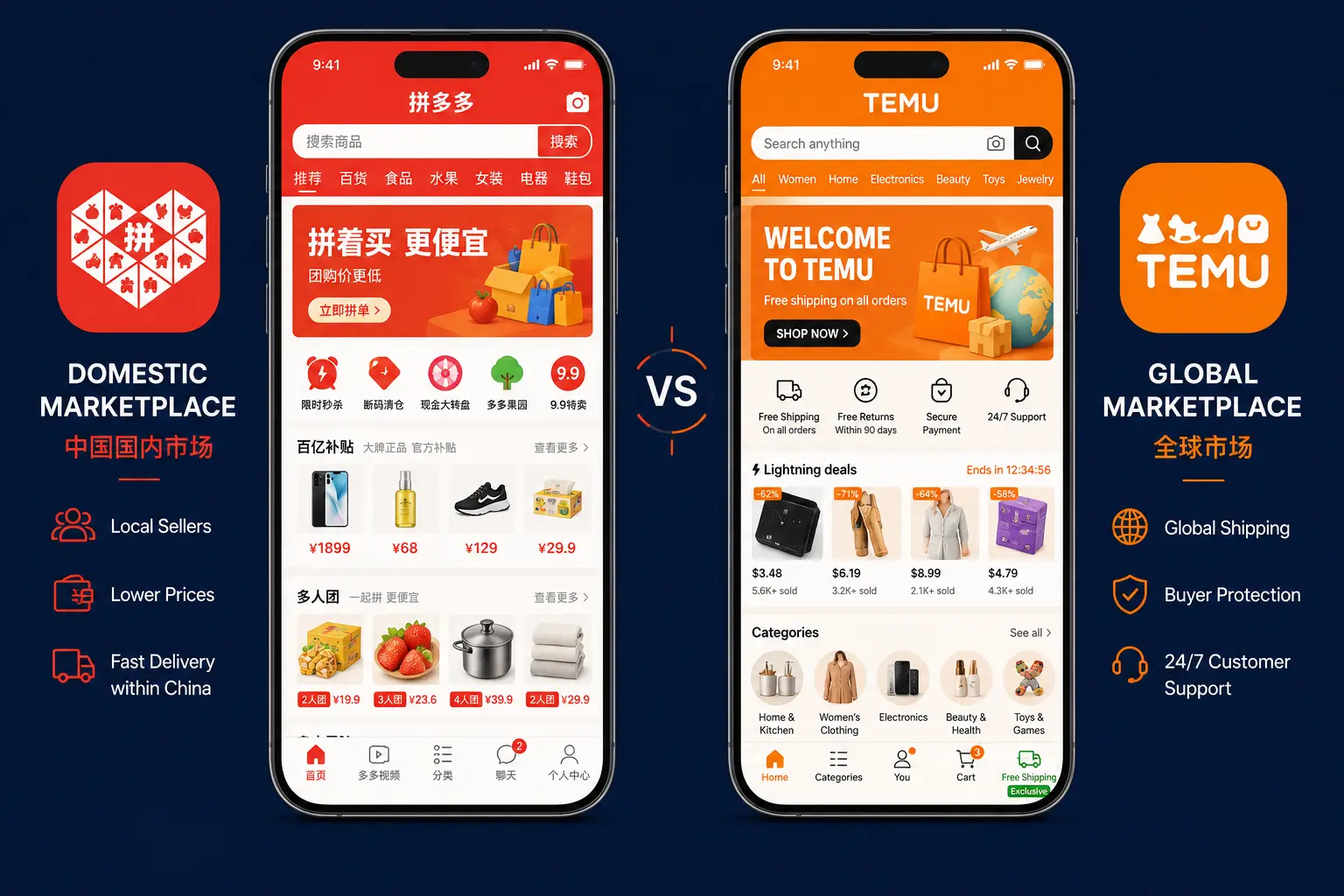
Pinduoduo vs Temu comes down to one fact most people never hear: they are sister platforms owned by the same parent company, PDD Holdings, but they are not the same marketplace. Pinduoduo is the Chinese domestic app where factories sell directly to Chinese buyers in RMB. Temu is the separate international consumer app built on top of that same supplier base, repackaged with its own pricing and logistics for buyers outside China. Having Temu on your phone in Nairobi does not give you a Pinduoduo account or Pinduoduo’s factory-floor prices, and neither platform is built to ship straight to Kenya. Pamoja Imports exists to close that specific gap.
- What Is Pinduoduo?
- What Is Temu, and How Is It Different?
- Pinduoduo vs Temu: Side-by-Side Comparison
- Does Temu Ship to Kenya?
- Can Kenyans Buy From Pinduoduo Directly?
- Product Quality and Counterfeit Risk on Either Platform
- Personal Purchase or Business Sourcing: Two Different Problems
- How Pamoja Imports Bridges the Gap
- Frequently Asked Questions
What Is Pinduoduo?
Pinduoduo (拼多多) launched in 2015, built by Colin Huang around a single idea: group buying. On Pinduoduo, almost every listing shows two prices, a solo price and a lower group price. Invite a few friends or family members to join your order, and the price drops for everyone in the group. Sellers accept the lower per-unit price because the group mechanic drives volume, and volume is what factories want. This is also where Temu’s name comes from: “Team Up, Price Down.”
The result is a platform that behaves less like a shop window and more like a live auction floor for Chinese manufacturers competing on price. Because Pinduoduo was built for the Chinese domestic market, it has never needed an English interface, international payment processing, or export-ready sellers. It is entirely in Chinese, priced in RMB, and most sellers have no experience shipping outside China at all.
A concrete example makes the mechanic clearer. A phone case listed at 8 RMB solo might drop to 5 RMB once four buyers join the same group order within a set time window, usually a few hours. The seller still profits at 5 RMB because they are moving four units at once instead of negotiating four separate transactions, and the group mechanic itself acts as free marketing, since every buyer who wants the lower price has an incentive to recruit others.
Multiply that dynamic across millions of daily transactions and the downward pressure on price becomes structural, not a one-off discount. This is also why Pinduoduo’s product catalog skews toward small, easily shipped, high-repeat-purchase items: phone accessories, kitchen tools, small electronics, and clothing, categories where the group mechanic works best.
The trade-off is that Pinduoduo’s group-buy interface was never designed with a foreign business buyer placing a single large wholesale order in mind. Bulk quantities at a fixed unit price, the kind a Kenyan importer actually needs, sit alongside the group-buy listings but require a different negotiation approach entirely, one that assumes the buyer can read and write Chinese and has a way to settle in RMB.
For a wider view of how Pinduoduo compares to Alibaba, 1688, and Made-in-China as sourcing options, see our Alibaba vs 1688 Kenya importer guide, which covers Pinduoduo from a sourcing-agent perspective rather than the consumer angle this guide focuses on.
What Is Temu, and How Is It Different?
PDD Holdings launched Temu in 2022 as a separate, international-facing marketplace. Temu draws on much of the same manufacturer network that supplies Pinduoduo, but the buyer experience is built from scratch for shoppers outside China: an English interface, local currency pricing, international card payments, and Temu’s own cross-border logistics network handling customs and delivery.
That last part is the one people miss. Temu does not simply forward you into Pinduoduo’s Chinese storefront. It repackages the same manufacturer base behind its own centrally controlled pricing and promotions, and its international shipping, customs handling, and marketing spend all get built into what you pay. The products can be identical to what is listed on Pinduoduo. The price rarely is.
What Are the Real Differences Between Pinduoduo and Temu?
Same parent company, opposite audiences: Pinduoduo is built for Chinese domestic buyers paying in RMB, Temu is built for international buyers paying in their own currency with logistics and marketing costs already folded into the price. The table below lines up the factors that actually matter for a Kenyan buyer deciding which one, if either, gets them closer to what they need.
| Factor | Pinduoduo | Temu |
|---|---|---|
| Parent company | PDD Holdings | PDD Holdings (same parent) |
| Built for | Chinese domestic consumers | International consumers |
| Language | Chinese only | English and other languages |
| Currency | RMB | Local currency at checkout |
| Realistic access route from Kenya | China-based agent or warehouse required | Third-country parcel forwarder |
| Typical pricing vs the other | Closer to factory-floor price | Logistics and marketing costs added on top |
| Best suited for | Bulk or wholesale sourcing via an agent | One-off personal purchases |
What surprises most people: neither platform officially ships to Kenya. The difference is in what closing that gap actually requires. Temu at least resembles a normal international checkout, so a forwarding service bolted onto a third-country address can work for a personal order. Pinduoduo was never built with an international consumer in mind at all, so the workaround has to happen further upstream, with someone physically inside China placing the order and receiving the goods.

Does Temu Ship to Kenya?
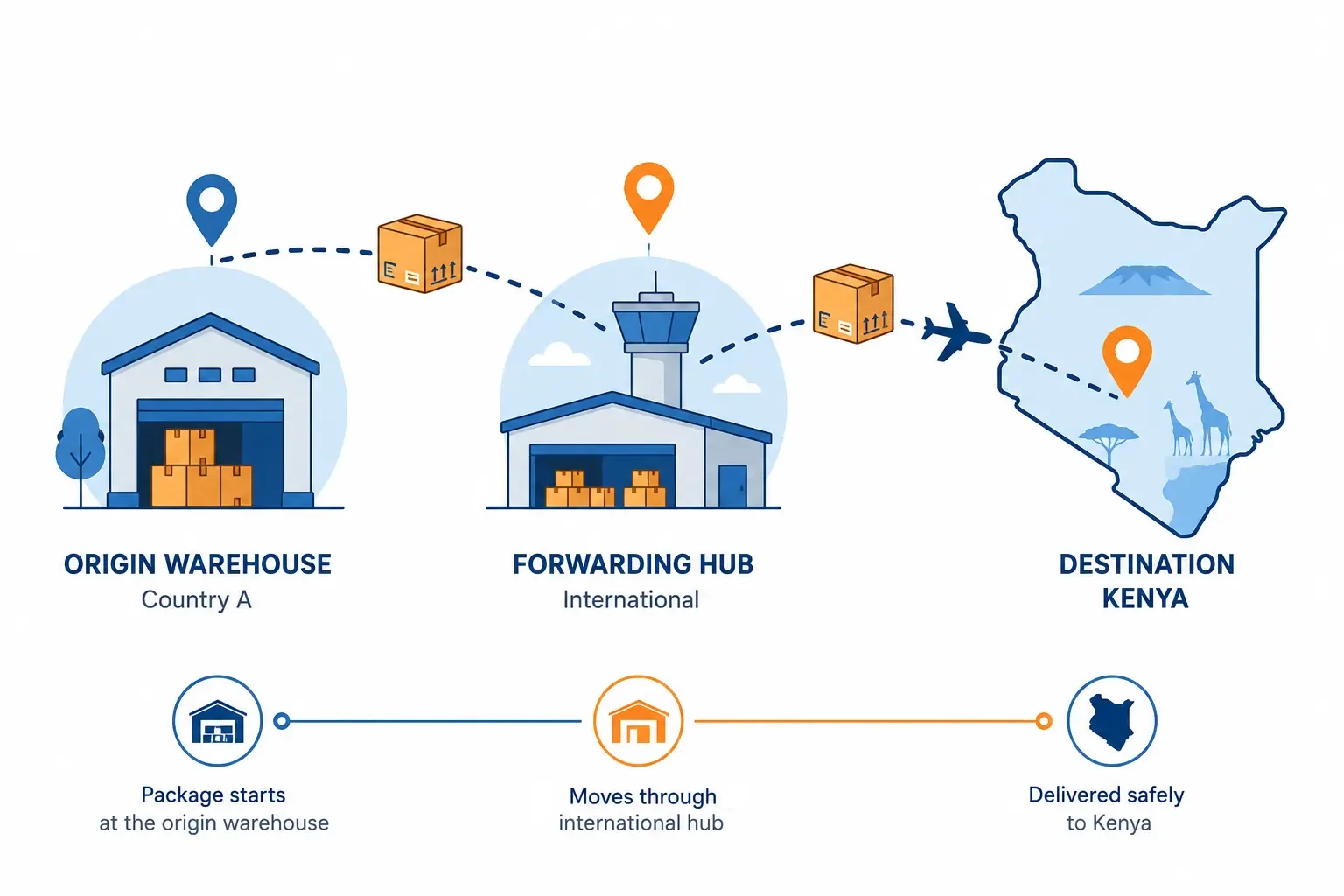
Not directly. Kenya is not currently among Temu’s listed direct-shipping destinations. The workaround that comes up most often online is a package-forwarding service: you order to an address in a country Temu does support, usually the US or UK, and the forwarder ships the parcel on to Kenya for an additional fee.
This can make sense for a single item or a small personal order, where the extra forwarding cost, typically in the $10 to $30 range for a small parcel, and the added week or two of transit time is a minor inconvenience. It stops making sense the moment you are trying to stock a shop or fill repeat orders, since every unit now carries a second shipping leg, a second point of possible delay, and no consolidation with anything else you are importing.
Can Kenyans Buy From Pinduoduo Directly?
Not practically. Pinduoduo’s checkout requires a Chinese delivery address, and payment runs through WeChat Pay, Alipay, or a Chinese bank card, none of which a Kenyan buyer holds by default. Pinduoduo’s own international shipping only reaches a short list of nearby Asian markets. Kenya is not one of them.
Anyone searching for a way to buy from Pinduoduo Kenya style, direct to their own address, will not find one. That means a solo attempt to buy from Pinduoduo out of Kenya does not fail at checkout because of some fixable setting. It fails at the address field, the payment method, and the shipping destination, three separate structural barriers, not one login problem.
The workaround is not something you can improvise by paying a random contact in China to place the order for you either. Without a track record, that person has no reason to inspect what actually gets shipped, and you have no recourse if it does not match the listing. This is the same trust problem a sourcing agent is built to solve: someone accountable, with a business reputation at stake, standing between you and the listing. For the full picture of how sourcing agents fit into supplier access more broadly, see our how to find reliable Chinese suppliers guide.
Is It Safe to Buy From Pinduoduo or Temu?
Both platforms are legitimate, publicly traded businesses, but intense seller competition on both creates a real incentive to cut corners on materials or trademark compliance. That risk is mostly a product-satisfaction issue for a personal purchase, but for goods entering Kenya as inventory it can mean a seizure at customs regardless of how cheaply the item was bought.
Low prices on both Pinduoduo and Temu come from the same place: intense seller competition and thin margins. That competition is real, but it also creates an incentive for some sellers to cut corners on materials, safety testing, or trademark compliance, since a listing with a slightly lower price wins the group-buy race regardless of what is actually inside the box. This is not unique to Pinduoduo or Temu, the same dynamic exists on 1688 and even parts of Alibaba, but the sheer listing volume and price pressure on Pinduoduo make it easier for a counterfeit or substandard item to slip through unnoticed until a full container has already landed.
For goods entering Kenya, this matters beyond product satisfaction. The Kenya Bureau of Standards requires a Pre-Export Verification of Conformity certificate for many product categories before they clear customs, and goods found to infringe a registered trademark or fail a safety standard can be seized at the port regardless of how cheaply they were bought. A bargain price on a group-buy listing does not exempt a shipment from PVoC requirements or IP enforcement once it reaches Mombasa or JKIA.
This is one of the practical reasons a China-based inspection step matters more than it might seem from Kenya. Someone who can physically check a sample against the listing photos, verify packaging and any required markings, and flag an obviously counterfeit branded item before it ships saves a Kenyan buyer from a seizure that no amount of online reviews would have predicted. Reviews on Pinduoduo and Temu are also easier to manipulate than most buyers assume, since the group-buy incentive structure rewards sellers for pushing volume through quickly, not necessarily for long-term reputation the way a storefront on Alibaba depends on.
Should You Buy for Yourself or Source Inventory to Resell?
Neither platform is something a Kenyan buyer operates alone, so the real question is who ends up doing the work instead of you. That answer depends entirely on whether you’re buying one item for yourself or sourcing inventory to resell.
Buying one or two items for yourself
- Temu, via a package-forwarding service, is the realistic option. You place the order yourself and pay a forwarder to handle the last leg into Kenya.
- Expect a forwarding fee on top of the item price and a longer wait than Temu’s own quoted delivery window.
- Keep the order small. Forwarding fees are often charged per shipment or by weight, so the economics get worse, not better, as the order grows.
Sourcing inventory to sell in Kenya
- Pinduoduo is not something you place an order on yourself, for the reasons already covered. The cost advantage still exists, but reaching it means someone else does the ordering, inspection, and receiving on your behalf.
- That is what a sourcing agent with a Chengdu-based team is for: clearing the access barriers already covered, inspecting goods before shipment, and consolidating multiple products into one shipment before anything reaches Kenyan customs.
- See our most profitable items to import from China to Kenya guide for which categories perform best when sourced this way.
How Pamoja Imports Bridges the Gap
Pamoja Imports sources directly on Pinduoduo through our team based in Chengdu, clearing the access barriers already covered in this guide. Our team negotiates with suppliers in Mandarin, inspects goods before anything ships, and consolidates your order with anything else you are importing into a single shipment.
Pamoja Imports: factory-floor Pinduoduo prices, without the Chinese phone number, payment method, or address problem
We source directly on Pinduoduo and 1688 for you, negotiate in Mandarin, inspect before shipment, and our all-in rate covers freight, import duty, VAT, IDF, RDL, and customs clearance to your door in Kenya. No hidden charges at the end.
- Chengdu-based team with the Chinese payment method and address a Pinduoduo order requires
- Sourcing negotiated directly in Mandarin, no translation guesswork
- Quality inspection before your order ships
- Sea freight 65,000 ksh/CBM or air freight 1,700 ksh/kg, all-in, no hidden fees
- Start from a 30,000 ksh minimum order
If you already know what you want to order and just need the shipping and clearance handled, see our ship from China to Kenya guide. If you are still deciding what to import, our most profitable items to import from China to Kenya guide breaks down margins and demand by category, and our profit calculator can estimate your landed cost and margin before you commit to an order.

Frequently Asked Questions: Pinduoduo vs Temu
For more answers to common questions about importing from China to Kenya, visit our Kenya import FAQ page.
No. Pinduoduo and Temu are sister platforms owned by the same parent company, PDD Holdings, and they share much of the same supplier base. But Pinduoduo is the Chinese domestic app, priced in RMB for Chinese buyers, while Temu is the separate international consumer app built on top of that supplier network for buyers outside China. Having Temu on your phone does not give you a Pinduoduo account or Pinduoduo’s factory-floor prices.
Not directly. Kenya is not currently listed among Temu’s supported direct-shipping destinations. Some buyers use a package-forwarding service, ordering to a US or UK address and paying to have it forwarded to Kenya, but this adds cost and time and is realistic for one or two personal items, not for stocking a business.
Not practically. Pinduoduo’s checkout is built for domestic Chinese delivery addresses and Chinese payment methods, WeChat Pay, Alipay, or a Chinese bank card. Its own international shipping only reaches a short list of nearby Asian countries, not Kenya. Without a Chinese phone number, a Chinese payment method, and someone to receive the goods inside China, a Kenyan buyer cannot complete a Pinduoduo order alone.
Pinduoduo prices are close to the raw factory listing, since sellers are competing directly for Chinese domestic buyers. Temu takes that same supplier base and adds international logistics, currency conversion, and marketing costs on top before the price reaches a buyer outside China. The products can be identical. The price is not.
Pamoja Imports sources directly on Pinduoduo through our Chengdu-based team, who hold the Chinese phone number, payment method, and delivery address that a Pinduoduo order actually requires. We negotiate with suppliers in Mandarin, inspect goods before they ship, and consolidate everything into one shipment with all-in freight, duty, and clearance to Kenya.
The platforms themselves are legitimate, publicly traded businesses under PDD Holdings, but intense seller competition on both creates an incentive to cut corners on materials or trademark compliance. For personal purchases the risk is mostly product satisfaction. For goods entering Kenya as inventory, counterfeit or non-compliant items can be seized at customs regardless of price, so a pre-shipment inspection step matters.
Not in the same way. Temu’s checkout is built for an international buyer with a card and a supported delivery country, so a forwarder simply provides the missing address. Pinduoduo’s checkout requires a Chinese payment method and phone number before a forwarder’s address ever comes into play, so the barrier sits earlier in the process and a forwarding address alone does not solve it.
Want Pinduoduo’s factory prices without the access problem?
Send us the product on WhatsApp. Our Chengdu team sources it on Pinduoduo, negotiates in Mandarin, and ships it all-in to Kenya.
Need Sourcing? I Have a Supplier
Jonatan Sirak sirak.se
Founder of Pamoja Imports, a Kenya-China import agency with an operations team based in Chengdu, China. With several years of hands-on experience facilitating shipments across electronics, solar equipment, construction materials, and consumer goods, he helps Kenyan entrepreneurs source and import products profitably. He splits his time between Nairobi and Chengdu.