

How to Import Solar Panels from China to Kenya: 2026 Guide
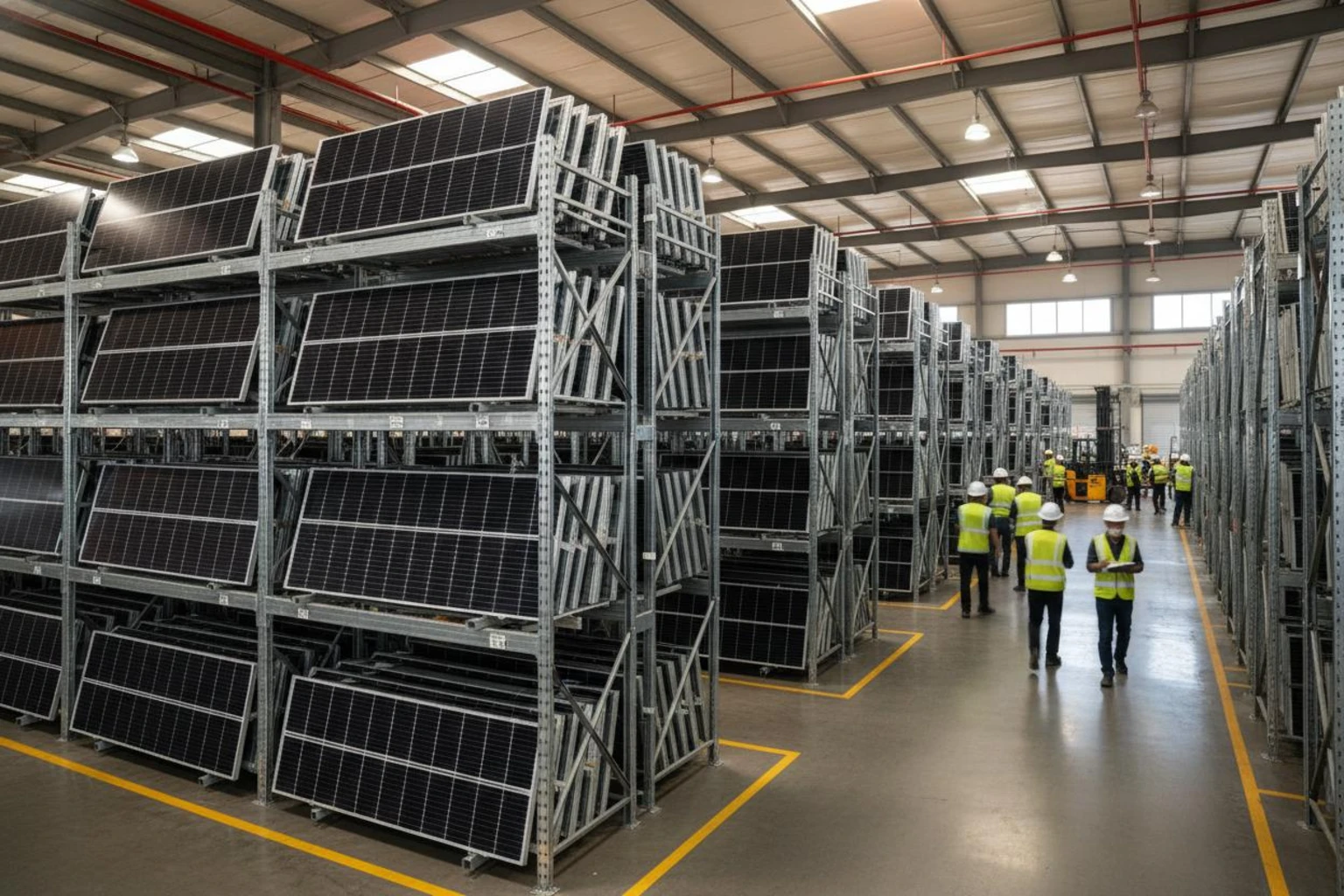
To import solar panels from China to Kenya, solar panels (HS 8541.40) enter duty-free and VAT-exempt, but system components including inverters, batteries, and charge controllers each carry separate duty rates and require individual assessment. Every consignment needs a KEBS Certificate of Conformity before shipment, and commercial importers require an EPRA Solar PV Vendor licence. Getting the HS code split wrong on a mixed system shipment is the most common and expensive mistake importers make.
- Why import solar panels from China to Kenya in 2026
- Duty rates and HS codes for every component
- KEBS PVoC and Certificate of Conformity
- EPRA vendor licence for importers
- The mixed shipment problem
- Full landed cost example in ksh
- How we source solar panels from China
- Shipping method and transit time
- Frequently asked questions
Why import solar panels from China to Kenya in 2026
More Kenyan importers are looking to import solar panels from China to Kenya than at any point in the past decade, and the economics driving that shift are straightforward. Chinese manufacturers produce roughly 80% of the world’s solar panels, and a global supply glut combined with US and European import restrictions has pushed prices down sharply, with panel prices dropping 40 to 50% over the past 18 months. Kenya is absorbing that surplus rapidly: in March 2026, Kenya imported more than 1 GW of solar from China in a single month for the first time, a 207% increase year on year.
On the demand side, Kenya’s off-grid energy market is expanding consistently. Commercial and industrial buyers are adding rooftop systems to reduce reliance on expensive Kenya Power grid electricity, while residential demand in peri-urban areas continues to grow. The result is a well-timed opportunity for importers, but one that requires getting the compliance and duty structure right before placing a first order.
Duty rates and HS codes for every component
This is where most importers get into trouble. “Solar panels” suggests a single product category, but a standard solar system shipment contains multiple distinct product types under the East African Community Common External Tariff, and each is treated differently at customs. Getting this wrong triggers reclassification, penalties, and KRA reassessment.
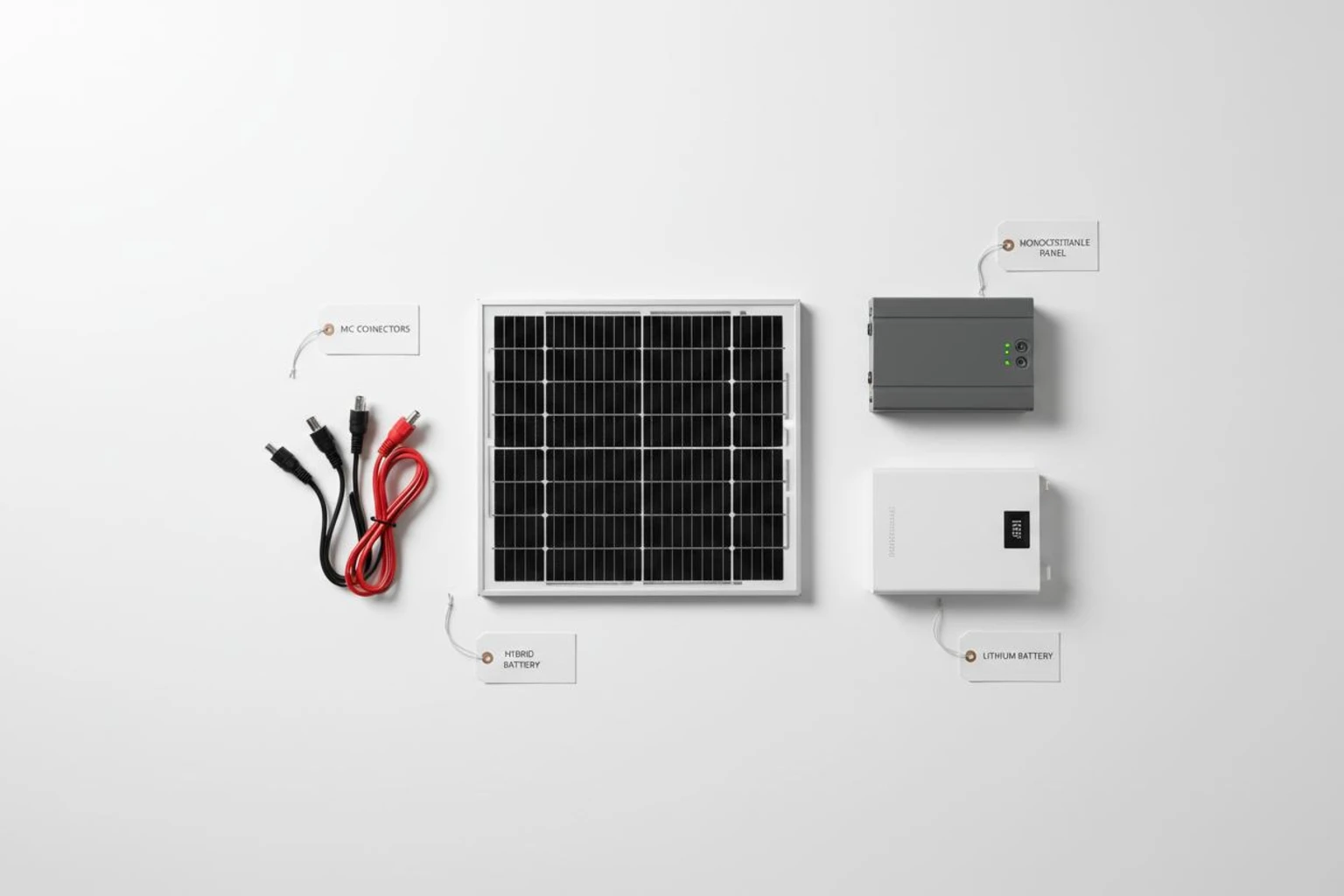
| Component | HS Code | Import Duty | VAT Status | Notes |
|---|---|---|---|---|
| Solar panels (modules) | 8541.40 | 0% | Exempt | Panels only, no integrated storage or micro-inverter |
| Inverters | 8504.40 | 10% | 16% | Solar and hybrid inverters |
| Solar charge controllers | 8504.40 | 10% | 16% | Some agents file under 9032.89: confirm HS with supplier |
| Lithium batteries | 8507.60 | 25% | See note | VAT status under review in Finance Bill 2026: verify before shipping |
| Lead-acid batteries | 8507.20 | 10% | 16% | Deep-cycle; heavier, lower energy density than lithium |
| Mounting structures | 7308.90 | 25% | 16% | Steel or aluminium racking |
| Solar cables and connectors | 8544.49 | 10% | 16% | MC4 connectors and PV cable |
The duty exemption on solar panels applies specifically to modules classified under HS 8541.40 containing no integrated storage, diodes, or micro-inverter components. A panel with a built-in micro-inverter may not qualify. If you import a hybrid all-in-one unit where the inverter and battery are physically integrated, KRA will typically assess the entire unit under the dominant component’s HS code, which means the panel exemption does not apply to it.
Confirming HS codes with your supplier before they prepare export documents is one of the most important steps in any solar shipment. A mismatch between the Chinese export declaration and the Kenyan import declaration is one of the most common causes of customs delays and unexpected reassessments. Our team in Chengdu handles this confirmation as standard before any order is placed.
For a full breakdown of how HS codes work and how to verify the correct code for any product, see our HS codes Kenya guide. For the complete Kenya duty formula including how VAT, IDF, and RDL stack on top of import duty, see our Kenya import duty from China guide.
KEBS PVoC and Certificate of Conformity
Solar panels are regulated goods under the KEBS Pre-Export Verification of Conformity programme. This means every consignment must be accompanied by a valid Certificate of Conformity issued in China by a KEBS-appointed inspection body before the shipment departs. Consignments that arrive without a CoC are subject to destination inspection at a fee of 5% of the approved customs value, and face potential rejection at the port.
As of March 2026, the KEBS-appointed inspection bodies for China are Cotecna and Intertek. Both are authorised to inspect solar panels and issue Certificates of Conformity for Kenya. Your Chinese supplier does not automatically obtain a CoC: you or your supplier must engage one of these bodies, submit product documentation and test reports based on the relevant Kenya Standards, and pass inspection before shipment.
What the CoC process involves for solar panels
- Submit product technical specifications and test reports to Cotecna or Intertek in China
- Inspection body reviews documentation against applicable Kenya Standards (KS IEC 61215 for crystalline silicon modules is the primary standard)
- Physical inspection or factory audit may be required depending on the inspection route and product risk level
- CoC is issued per consignment, not per product type: you need a new CoC for each shipment
- For system components that are not exempt (inverters, batteries), a separate CoC is required for those items
Engaging the right inspection body and tracking CoC status against your shipment timeline is where first-time solar importers most often lose time. We coordinate the CoC process directly with Cotecna or Intertek in China on every solar order we handle.
EPRA vendor licence for importers
This is the requirement that catches the most first-time solar importers off guard. Under Kenya’s Energy (Solar Photovoltaic Systems) Regulations, anyone importing solar PV products commercially requires an EPRA Solar PV Vendor licence (Class V1 or V2 depending on scope). This applies to importers who sell solar products into the Kenyan market, not just manufacturers or installers.
The licence application is processed through the EPRA online portal. You will need your company’s Certificate of Incorporation, a KRA Tax Compliance Certificate, and a completed application. EPRA’s published processing time is 21 working days. Operating as a commercial solar importer without a valid EPRA licence exposes you to penalties and potential seizure of goods at the border.
If you are importing solar commercially for the first time, we recommend confirming your EPRA licence status before your first shipment arrives. We can advise on the application process as part of our onboarding for new clients.
The mixed shipment problem
Most solar system importers do not ship panels alone. A typical order includes panels, an inverter, a battery bank, a charge controller, cables, and mounting hardware, all in the same container. This is where the customs process becomes genuinely complicated and where errors are most costly.

Because panels attract 0% import duty and VAT exemption while other components do not, a single mixed shipment must be processed as if it were two separate imports. The correct approach requires submitting separate Import Declaration Forms and separate Certificates of Conformity for the exempt items (panels) and the non-exempt items (inverter, battery, cables, mounting), with the commercial invoice broken down to show the value of each component group individually.
If the invoice from your Chinese supplier shows a single line item for a “complete solar system kit,” customs will assess the entire shipment under the dominant component’s HS code or, more commonly, apply duty to the full invoice value. Either outcome means you lose the panel exemption entirely.
How to structure your order to protect the exemption
- Instruct your supplier to issue a single invoice with each component listed separately, with individual unit prices and quantities
- Confirm the HS code with your supplier for each component before they prepare export documents
- Request separate packing lists for exempt and non-exempt items where possible
- Ensure your clearing agent files two IDFs: one for the exempt panels, one for all other components
- Obtain a CoC covering the panels separately from a CoC covering the non-exempt components
On paper the process is clear. In practice, coordinating it across a first shipment involves enough moving parts that errors are common: confirming HS codes with a Chinese supplier, obtaining two separate CoCs from an inspection body in China, and ensuring your clearing agent files dual IDFs correctly. It is the single aspect of solar importing we get asked to take over most often by importers who have tried it independently first.
Full landed cost example in ksh
The example below uses a realistic small commercial order: 40 x 550W monocrystalline panels, a 5kW hybrid inverter, a 10kWh lithium battery bank, and cables and mounting hardware. It shows the full going-alone cost with duties broken out, then the Pamoja all-in equivalent.
All tax calculations use CIF value (FOB plus allocated sea freight) as the base, which is how KRA calculates duty. Standalone sea freight is estimated at 30,000 ksh per CBM, total 1.2 CBM. Clearing agent fee estimated at 15,000 ksh. IDF at 2.5% and RDL at 2% applied to CIF of non-exempt items.
| Item | FOB (ksh) | CIF (ksh) | Duty | VAT | IDF + RDL | Total (ksh) |
|---|---|---|---|---|---|---|
| 40 x 550W panels | 130,000 | 147,000 | 0% | Exempt | Exempt | 147,000 |
| 5kW hybrid inverter | 45,000 | 51,000 | 5,100 | 8,976 | 2,295 | 67,371 |
| 10kWh lithium battery | 80,000 | 90,667 | 22,667 | 18,133 | 4,080 | 135,547 |
| Cables, mounting (est.) | 15,000 | 17,000 | 1,700 | 2,992 | 765 | 22,457 |
| Sea freight (standalone est.) | 30,000 ksh/CBM x 1.2 CBM | 36,000 | ||||
| Clearing agent (est.) | 15,000 | |||||
| Going alone total | ~388,000 | |||||
How we source solar panels from China
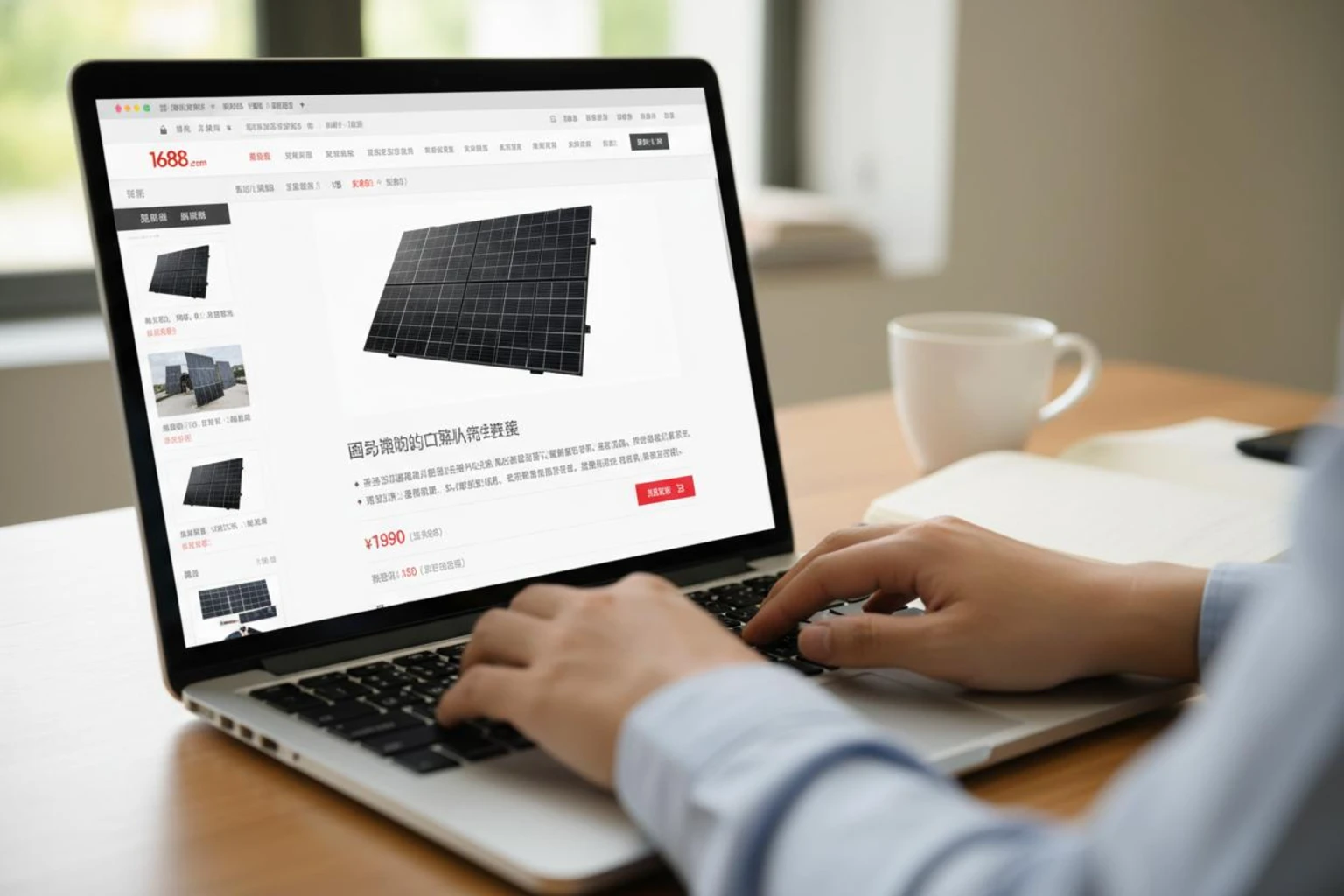
1688 and Pinduoduo are Chinese domestic platforms that require a Chinese phone number to register and are navigated in Mandarin. Kenyan importers cannot access them directly. Our team in Chengdu sources from these platforms on your behalf, which is where the pricing advantage over Alibaba comes from: you are buying at domestic Chinese wholesale rates, not the export-marked-up prices listed for international buyers.
For solar panels, 1688 is the primary sourcing platform. Our team searches by wattage, cell type (monocrystalline is the current standard for efficiency), efficiency rating, and certification status. Panel accessories and smaller system components come through Pinduoduo where pricing is sharper for volume orders.
What we verify before recommending a supplier
- IEC certification: Panels should carry IEC 61215 (crystalline silicon) or IEC 61646 (thin film) certification from an accredited body. This is required for the KEBS CoC process. Suppliers without it cannot support compliance.
- Export documentation experience: We check whether the supplier has previously exported to Kenya or East Africa. Suppliers with CoC experience prepare documentation correctly the first time, which avoids clearance delays.
- Separate invoicing capability: The supplier must be able to issue an itemised invoice with individual unit prices per component. This is non-negotiable for the mixed shipment dual-IDF process.
- HS code alignment: We confirm the supplier’s export HS code for each item matches the Kenyan import classification before export documents are prepared. Discrepancies trigger customs queries.
- Sample order: For a first-time solar order, we recommend sourcing 4 to 6 sample panels before committing to a full shipment. The cost is small relative to the risk of a quality issue at scale.
What to look for in a solar panel regardless of how you source it
Panel quality is not just about price per watt. These are the specifications that determine whether a panel performs as expected over its lifespan:
- Power output tolerance: A good panel is rated at 0/+3% tolerance, meaning it will produce at or above its rated wattage. Avoid panels rated at -3%/+3%, which can legally deliver 3% less than advertised.
- Temperature coefficient: This measures how much power output drops as the panel heats up. A coefficient of -0.35%/°C or better is the standard for Kenyan conditions. Cheaper panels often run at -0.45% or worse, losing significantly more output on hot days.
- Efficiency rating: Monocrystalline panels now commonly reach 21 to 23% efficiency. Anything below 19% is an older or lower-grade cell. Higher efficiency means fewer panels needed for the same output.
- Warranty terms: Reputable manufacturers offer a 25-year linear power output warranty (guaranteeing at least 80% of rated output after 25 years) and a 10 to 12-year product warranty covering manufacturing defects. Verify this is from the manufacturer, not just the supplier.
- Cell type: Monocrystalline PERC and TOPCon cells are the current standard. Avoid polycrystalline panels for new installations: they are cheaper but significantly less efficient and are being phased out by most manufacturers.
For more on how we find and vet suppliers across product categories, see our how to find Chinese suppliers guide.
Shipping method and transit time
Solar panels are heavy and bulky relative to their value, which makes air freight economically unworkable for most commercial orders. A set of 40 x 550W panels weighs roughly 800 kg and occupies around 1.0 CBM. Air freight for that volume runs 15 to 20 times the cost of sea freight on a per-CBM basis. Sea freight is the only practical choice for panel imports.
Transit time from a Chinese warehouse to Mombasa via sea freight is 30 to 35 days, followed by 5 to 10 days for customs clearance and Nairobi delivery. Plan for a total lead time of 40 to 45 days from order confirmation to goods in hand. For a full comparison of sea versus air freight on other product types, see our sea freight vs air freight guide.
Pamoja Imports: Solar Panel Sourcing and Shipping, All-In
Sourcing solar panels from China involves more compliance steps than most product categories. We handle the supplier search on 1688, coordinate your KEBS Certificate of Conformity, manage the dual-IDF process for mixed system shipments, and ship all-in at 65,000 ksh per CBM including import duty, VAT, and customs clearance to Nairobi.
- Supplier sourcing on 1688 and Pinduoduo, first 10 products free
- Certificate of Conformity coordination with KEBS-appointed inspection bodies in China
- Separate IDF filing for exempt and non-exempt components
- Sea freight at 65,000 ksh per CBM, all-in, no hidden fees
- Minimum order: 30,000 ksh excluding shipping
Frequently asked questions
For more answers on importing from China to Kenya, visit our Kenya import FAQ page.
Solar panels (HS code 8541.40) attract 0% import duty and are currently VAT-exempt in Kenya. System components like inverters (HS 8504.40, 10% duty) attract import duty and 16% VAT. Lithium batteries (HS 8507.60, 25% duty) have a VAT status subject to ongoing legislative review under the Finance Bill 2026. Verify the current position with KRA or your clearing agent before shipping. Always confirm the HS code for each component.
Yes. Solar panels are regulated goods under the KEBS PVoC programme. Every consignment must be accompanied by a Certificate of Conformity issued by a KEBS-appointed inspection body in China before shipment. As of March 2026, Cotecna and Intertek are the appointed agents for China. Shipments arriving without a valid CoC face destination inspection at 5% of the customs value.
Yes. Anyone importing solar PV products commercially in Kenya requires an EPRA Solar PV Vendor licence under the Energy (Solar Photovoltaic Systems) Regulations. The application is processed through the EPRA online portal. Operating without a licence exposes you to penalties and seizure of goods.
Yes, but the customs process requires separate handling for exempt and non-exempt items. Panels are duty and VAT exempt; inverters, batteries, and charge controllers attract duty and VAT. You must submit separate IDFs and Certificates of Conformity for exempt and non-exempt items in the same consignment, or have the invoice broken down so each component is separately assessed.
Sea freight is the only practical option for solar panels. Panels are bulky and heavy, and air freight costs 15 to 20 times more per CBM than sea freight for this type of cargo. Transit time via sea freight is 30 to 35 days from a Chinese port to Mombasa, plus 5 to 10 days for customs clearance and Nairobi delivery. Total lead time is typically 40 to 45 days from order confirmation.
Ready to import solar panels from China?
Submit a source request and we will find the right supplier, handle the compliance paperwork, and ship all-in to Nairobi.
Submit a Source Request
Jonatan Sirak sirak.se
Founder of Pamoja Imports, a Kenya-China import agency with an operations team based in Chengdu, China. With several years of hands-on experience facilitating shipments across electronics, solar equipment, construction materials, and consumer goods, he helps Kenyan entrepreneurs source and import products profitably. He splits his time between Nairobi and Chengdu.