
FOB vs CIF Kenya: Avoid the Costly CIF Mistake 2026
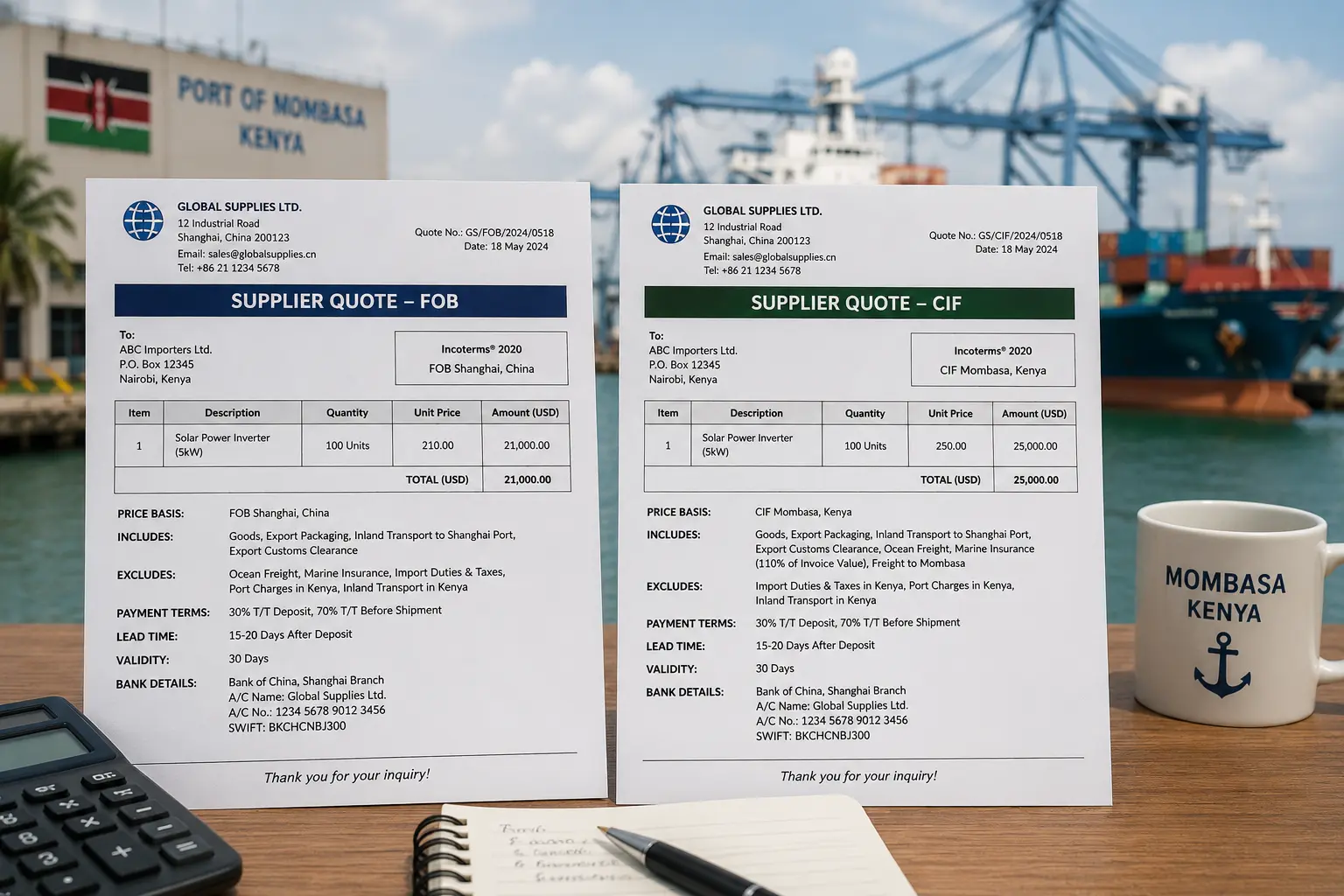
The FOB vs CIF Kenya decision almost always resolves in favour of FOB. Under FOB, your supplier loads goods onto the vessel at the Chinese port and you control the freight from there. Under CIF, your supplier arranges and pays freight to Mombasa. The critical Kenya-specific problem with CIF: KRA calculates your import duty, VAT, IDF, and RDL on the CIF value of your goods. If a supplier inflates their CIF freight quote, every tax you pay rises with it. FOB gives you control over the freight cost and keeps your taxable CIF value lower.
- What are Incoterms and why do they matter in Kenya?
- What FOB means for Kenya importers
- What CIF means for Kenya importers
- The Kenya-specific tax problem with CIF
- Real ksh example: FOB vs CIF Kenya, same goods, different tax
- EXW: what it is and why most Kenya importers should avoid it
- FOB vs CIF vs EXW: side-by-side comparison
- When CIF is acceptable
- What Pamoja’s all-in rate means in Incoterm terms
- Frequently Asked Questions
When you request a quote from a Chinese supplier, they will almost always give you a price in one of three formats: FOB, CIF, or EXW. The FOB vs CIF Kenya choice is one of the most consequential decisions a Kenya importer makes, yet most first-time importers accept whichever term the supplier offers without understanding what they are agreeing to. That decision can add tens of thousands of shillings to your landed cost. With Pamoja, this is something you do not need to worry about.
This guide explains FOB vs CIF for Kenya importers sourcing from China in plain language, with a real worked ksh example showing exactly how the choice affects your KRA tax bill. It also covers EXW, which appears in some supplier quotes and carries the most risk of all three terms for importers who do not have logistics support in China.
If you are still building your understanding of what you pay when goods arrive in Kenya, read our Kenya import duty guide first. The FOB vs CIF distinction only makes full sense once you understand that Kenya taxes you on CIF value, not FOB value. And since that entire tax bill is due before your goods are released, see our guide on cash flow when importing from China to Kenya for what that means for your working capital.
What are Incoterms and why do they matter in Kenya?
Incoterms, short for International Commercial Terms, are a standardised set of trade rules published by the International Chamber of Commerce. They define where the supplier’s responsibility ends and where yours begins at every stage of a shipment: who pays for what, who bears the risk of loss or damage, and who handles which logistics tasks.
There are 11 Incoterms in total, but for Kenya importers sourcing from China, three come up in practice: FOB, CIF, and EXW. The FOB vs CIF Kenya question is not just a paperwork exercise. The Incoterm you agree to with your supplier directly determines your total landed cost in Kenya, because Kenya Revenue Authority bases your entire tax calculation on the CIF value of your goods.
This is the Kenya-specific angle that most generic Incoterms guides miss entirely. A supplier who quotes you an inflated CIF freight rate is not just overcharging you for shipping. They are raising the base on which every tax you pay in Kenya is calculated. The knock-on effect through duty, VAT, IDF, and RDL adds up to a significant sum. We show you exactly how in the worked example below.
What FOB means for Kenya importers
FOB stands for Free on Board. In the context of importing from China to Kenya, FOB means the Chinese supplier is responsible for getting your goods onto the vessel at the named Chinese port. Once the goods are physically loaded on board the ship, responsibility transfers to you as the buyer.
From that point, you control and pay for everything: ocean freight from China to Mombasa, customs clearance at the Kenyan port, import duty, VAT, IDF, RDL, and inland delivery to Nairobi. The supplier’s job is done once the goods are on the ship.
In practice, most Kenya importers using an all-in freight service like Pamoja Imports are effectively operating on FOB terms. The supplier loads onto the vessel at, for example, Shanghai or Guangzhou. Pamoja’s team takes control of the freight from that point, handling consolidation, transit to Mombasa, customs clearance, duty payment, and delivery to our Nairobi warehouse. Because Pamoja controls the freight leg, the freight cost going into your CIF calculation is genuine and transparent, not inflated by a supplier’s preferred shipper.

What the supplier does under FOB
- Packs and prepares goods for export
- Handles inland transport to the Chinese port
- Clears export customs in China
- Loads goods onto the vessel at the named port
- Issues a commercial invoice and packing list
What you do under FOB
- Book and pay for sea or air freight from the Chinese port to Mombasa or JKIA
- Arrange or confirm cargo insurance if required
- Handle Kenya customs clearance through a KRA-licensed clearing agent
- Pay import duty, VAT, IDF, and RDL on the CIF value
- Arrange inland delivery from the port to your warehouse or store
The main advantage of FOB is control. Because you are choosing and paying for the freight directly, you know exactly what it costs. That cost feeds into your CIF calculation honestly. And as we show in the example below, a lower CIF value means lower taxes across the board.
What CIF means for Kenya importers
CIF stands for Cost, Insurance, and Freight. Under CIF, the supplier arranges and pays for the ocean freight and basic insurance to the named destination port, which for Kenya importers is typically Mombasa. You take responsibility once the goods arrive at Mombasa Port.
On the surface, CIF sounds convenient. The supplier handles the shipping. You do not need to find a freight forwarder or manage logistics from China. You simply wait for your goods to arrive.
The problem is that “convenient” has a cost, and that cost is often invisible until it shows up on your KRA duty assessment. Here is why.
The CIF trap most importers miss
When a supplier quotes CIF Mombasa, they choose their own freight forwarder, book on their preferred shipping line, and add a margin. Some suppliers add a small margin. Others add a significant one. You often have no way to know what the actual freight cost was versus what the supplier declared. More importantly, that declared freight cost becomes part of your CIF customs value, and KRA taxes you on all of it.
The Kenya-specific tax problem with CIF
This is the most important section for any Kenya importer working through the FOB vs CIF Kenya decision. Kenya Revenue Authority uses the CIF customs value as the base for every import tax you pay. The formula is:
CIF Value = FOB price of goods + Freight cost + Insurance cost
Every tax stacks on top of this CIF value:
- Import duty: 0% to 35% applied to CIF value, depending on your HS code
- VAT: 16% applied to CIF value plus import duty
- IDF: 2.5% applied to CIF value
- RDL: 2% applied to CIF value
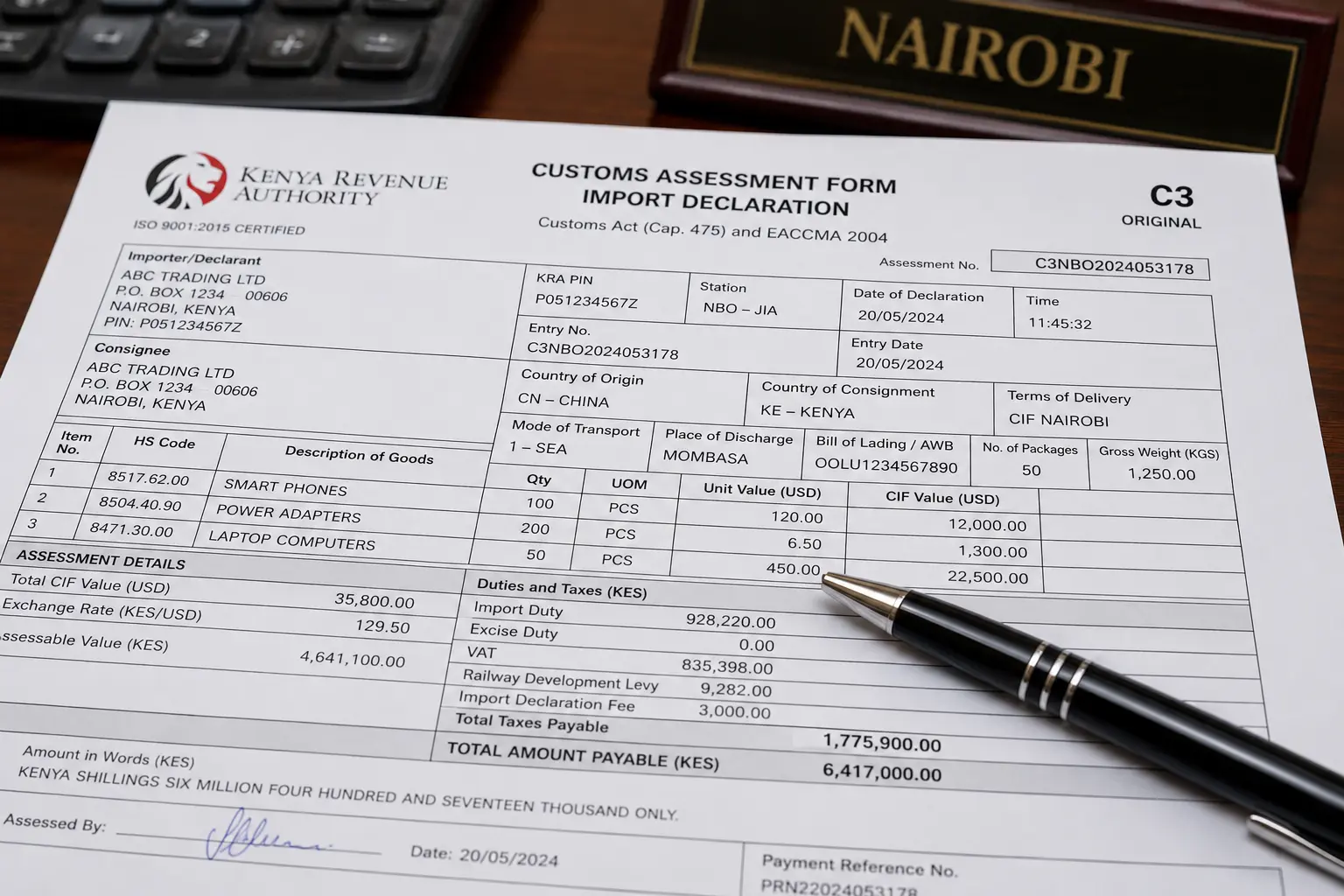
When you use CIF incoterms, the freight figure your supplier declares becomes part of that taxable base. If the supplier declares 80,000 ksh in freight where the real market rate was 55,000 ksh, you have just added 25,000 ksh to your CIF value. On a 25% duty product, that inflated freight adds roughly 6,250 ksh in extra import duty, plus additional VAT, IDF, and RDL on top. The compounding effect is real.
When you use FOB and arrange your own freight with a transparent provider, you know exactly what the freight costs. That number feeds into your CIF value accurately, and your taxes are calculated on a number you can verify and control.
For a full breakdown of how Kenya’s import taxes are calculated and stacked, see our Kenya import duty from China guide.
Real ksh example: FOB vs CIF Kenya, same goods, different tax
The following example uses the same shipment under two different incoterms to show exactly how FOB vs CIF affects your total cost in Kenya. The product is general merchandise attracting 25% import duty.
Shipment details: 200 units of kitchen accessories. FOB value: 80,000 ksh. Volume: 0.8 CBM via sea freight.
| Cost component | FOB (independent freight) | CIF (supplier-arranged) |
|---|---|---|
| FOB goods value | 80,000 ksh | 80,000 ksh |
| Freight cost declared | 52,000 ksh (0.8 CBM at market rate) | 75,000 ksh (supplier-inflated) |
| CIF customs value | 132,000 ksh | 155,000 ksh |
| Import duty (25% of CIF) | 33,000 ksh | 38,750 ksh |
| VAT (16% of CIF + duty) | 26,400 ksh | 31,000 ksh |
| IDF (2.5% of CIF) | 3,300 ksh | 3,875 ksh |
| RDL (2% of CIF) | 2,640 ksh | 3,100 ksh |
| Total tax paid to KRA | 65,340 ksh | 76,725 ksh |
| Extra tax from CIF inflation | +11,385 ksh |
On a single 0.8 CBM shipment, an inflated CIF freight quote adds over 11,000 ksh in extra taxes. Scale that across multiple shipments per year and the cost becomes substantial. The supplier pockets the freight margin. You pay the inflated tax bill.
This example uses conservative numbers. On larger shipments or products with higher duty rates, the gap widens further. The underlying principle is always the same: every extra ksh added to your CIF value multiplies through every tax line.
EXW: what it is and why most Kenya importers should avoid it
EXW stands for Ex Works. Under EXW, the supplier’s obligation ends at their factory gate or warehouse. Everything from that point is your responsibility: collecting the goods from the factory, inland transport to the Chinese port, export customs clearance in China, booking freight to Kenya, customs clearance at Mombasa, duty payment, and Nairobi delivery.
On paper, EXW looks attractive because the product price appears lower. The supplier is quoting you only for making the goods available. In practice, EXW is the most operationally complex term for Kenya importers and carries the highest risk of hidden costs and delays.
The main problems with EXW for Kenya importers:
- China-side logistics: You need someone physically in China to collect goods from the factory, move them to the port, and handle Chinese export customs clearance. Without a China-based partner, this is extremely difficult to manage remotely.
- Export documentation risk: Chinese export customs requires specific documentation. If the supplier’s factory is in an inland city, getting goods to the port involves additional costs and coordination that are easy to underestimate from Nairobi.
- No supplier accountability: Under EXW, the supplier’s job is done once they make goods available. Any damage, loss, or delay after that point is entirely your problem.
- Hidden costs materialise late: Importers who accept EXW quotes and later try to arrange logistics from Kenya typically discover the China-side costs were not in their budget, and by then the order is already placed.
Unless you have a freight partner with physical presence in China who can handle the factory pickup and export customs on your behalf, decline EXW and request FOB instead.

FOB vs CIF vs EXW: side-by-side comparison
| Responsibility | EXW | FOB | CIF |
|---|---|---|---|
| Factory packing and preparation | Supplier | Supplier | Supplier |
| Inland transport to Chinese port | You | Supplier | Supplier |
| Chinese export customs clearance | You | Supplier | Supplier |
| Loading onto vessel at Chinese port | You | Supplier | Supplier |
| Ocean freight to Mombasa | You | You | Supplier |
| Cargo insurance | You | You (optional) | Supplier (minimal) |
| Kenya customs clearance | You | You | You |
| Import duty, VAT, IDF, RDL | You | You | You |
| Inland delivery to Nairobi | You | You (or included with Pamoja) | You (or included with Pamoja) |
| Control over freight cost | Partial | Full | None |
| Tax base visibility | Full | Full | Partial |
| Recommended for Kenya SME importers | No | Yes | Cautiously |
When CIF is acceptable for Kenya importers
FOB is the better default, but CIF is not always the wrong choice. There are situations where accepting CIF from a supplier is reasonable:
Very small first orders. On a small trial order where you are primarily testing product quality rather than optimising cost, the tax difference between FOB and CIF may be modest enough that the simplicity of CIF is acceptable. Always verify the freight component is at market rate before accepting.
When you can verify the freight cost independently. If a supplier quotes CIF and you can get an independent freight quote from a forwarder for the same route and volume, compare them. If the supplier’s CIF freight is within 10 to 15% of the market rate, the inflated CIF risk is limited. If their freight is 40 to 60% above market, decline CIF and request FOB.
When a trusted supplier with transparent pricing offers CIF. Some established suppliers quote CIF at genuine market rates without a margin. This is relatively rare, but if you have a long-standing relationship with a factory and can verify their freight cost is not inflated, CIF can work. Always request a breakdown showing the freight component separately.
What Pamoja’s all-in rate means in Incoterm terms
When you use Pamoja Imports, we work with your supplier on FOB terms. The supplier loads goods onto the vessel at the Chinese port. Pamoja’s team takes control of the freight from that point, handling consolidation into a shared container (LCL) or a dedicated container, transit to Mombasa, customs clearance with KRA, import duty, VAT, IDF, RDL, and delivery to our Nairobi warehouse.
Because Pamoja controls the freight leg, the freight cost feeding into your CIF customs value is the actual market cost, not a supplier-inflated figure. You are not exposed to the CIF trap described above.
The all-in rate of 65,000 ksh per CBM (sea freight) or 1,700 ksh per kg (air freight, standard goods) covers everything from the Chinese port to our Nairobi warehouse. There is no separate duty invoice arriving after your goods, no surprise clearing fee at Mombasa, and no second agent to coordinate. You pay one number and your goods arrive.
For the full breakdown of what is included in Pamoja’s rates and how the shipping process works, see our guide to shipping from China to Kenya.
Pamoja Imports: one rate, no CIF surprises
We work on FOB terms from China, which means the freight cost in your CIF calculation is real and transparent. Our all-in rate covers sea freight, air freight, import duty, VAT, IDF, RDL, and Kenya customs clearance. What you see in your quote is what you pay when goods arrive at our Nairobi warehouse.
- Sea freight: 65,000 ksh/CBM all-in (min 0.1 CBM)
- Air freight: 1,700 ksh/kg all-in standard goods (min 1 kg)
- Operations team based in Chengdu, China
- Sourcing from Pinduoduo, 1688, and Taobao at factory-direct prices
Frequently Asked Questions
For more answers to common questions about importing from China to Kenya, visit our Kenya import FAQ page.
Under FOB, the supplier loads goods onto the vessel at the Chinese port and responsibility transfers to you from that point. You arrange and pay your own freight to Kenya. Under CIF, the supplier arranges and pays freight and insurance to Mombasa, and you take responsibility on arrival. For Kenya importers, FOB is almost always better because Kenya uses CIF value as the customs valuation base. If your supplier inflates the CIF freight cost, your import duty, VAT, IDF, and RDL all rise with it.
Yes, directly. Kenya Revenue Authority calculates import duty, VAT, IDF, and RDL on the CIF value of your goods: the combined cost of the goods, freight, and insurance. If you use CIF incoterms and your supplier quotes inflated freight, your taxable CIF value rises and every tax you pay rises with it. Using FOB and arranging your own freight gives you control over that freight cost and keeps your CIF value lower.
FOB stands for Free on Board. In the context of importing from China to Kenya, FOB means the Chinese supplier is responsible for delivering your goods onto the vessel at the named Chinese port. Once the goods are on board, you as the buyer bear all costs and risk for the rest of the journey: freight to Mombasa, customs clearance, import duty, VAT, IDF, RDL, and inland delivery. Most Kenya importers using an all-in freight service like Pamoja Imports effectively operate on FOB terms, as the freight from the Chinese port to Nairobi is controlled and transparent.
EXW places maximum responsibility on you as the buyer. Under EXW, your obligation starts at the supplier’s factory gate in China. You must arrange pickup from the factory, inland transport to the Chinese port, export customs clearance in China, sea or air freight to Kenya, and full customs clearance and duty payment in Kenya. Unless you have a freight partner physically based in China who can handle the China-side logistics, EXW creates serious operational risk. Most Kenya SME importers should use FOB instead.
CIF can be acceptable for very small first orders where the tax difference is minimal, or when you can independently verify the supplier’s freight quote is at market rate. For regular orders above 30,000 ksh, always compare a FOB-plus-independent-freight total against the supplier’s CIF quote before deciding. If the supplier’s CIF freight is more than 15% above the market rate, use FOB.
Pamoja Imports works with suppliers on FOB terms from China. We control the freight leg from the Chinese port to our Nairobi warehouse, which means we offer a genuinely transparent all-in rate covering sea or air freight, import duty, VAT, IDF, RDL, and customs clearance. You pay one ksh figure and your goods arrive. There are no separate invoices for duty, no port surprise fees, and no separate clearing agent to coordinate.
Ready to import from China to Kenya?
Send us your product and we will give you a full landed cost quote in ksh before you commit to anything.
Get a free quote
Jonatan Sirak sirak.se
Founder of Pamoja Imports, a Kenya-China import agency with an operations team based in Chengdu, China. With several years of hands-on experience facilitating shipments across electronics, solar equipment, construction materials, and consumer goods, he helps Kenyan entrepreneurs source and import products profitably. He splits his time between Nairobi and Chengdu.