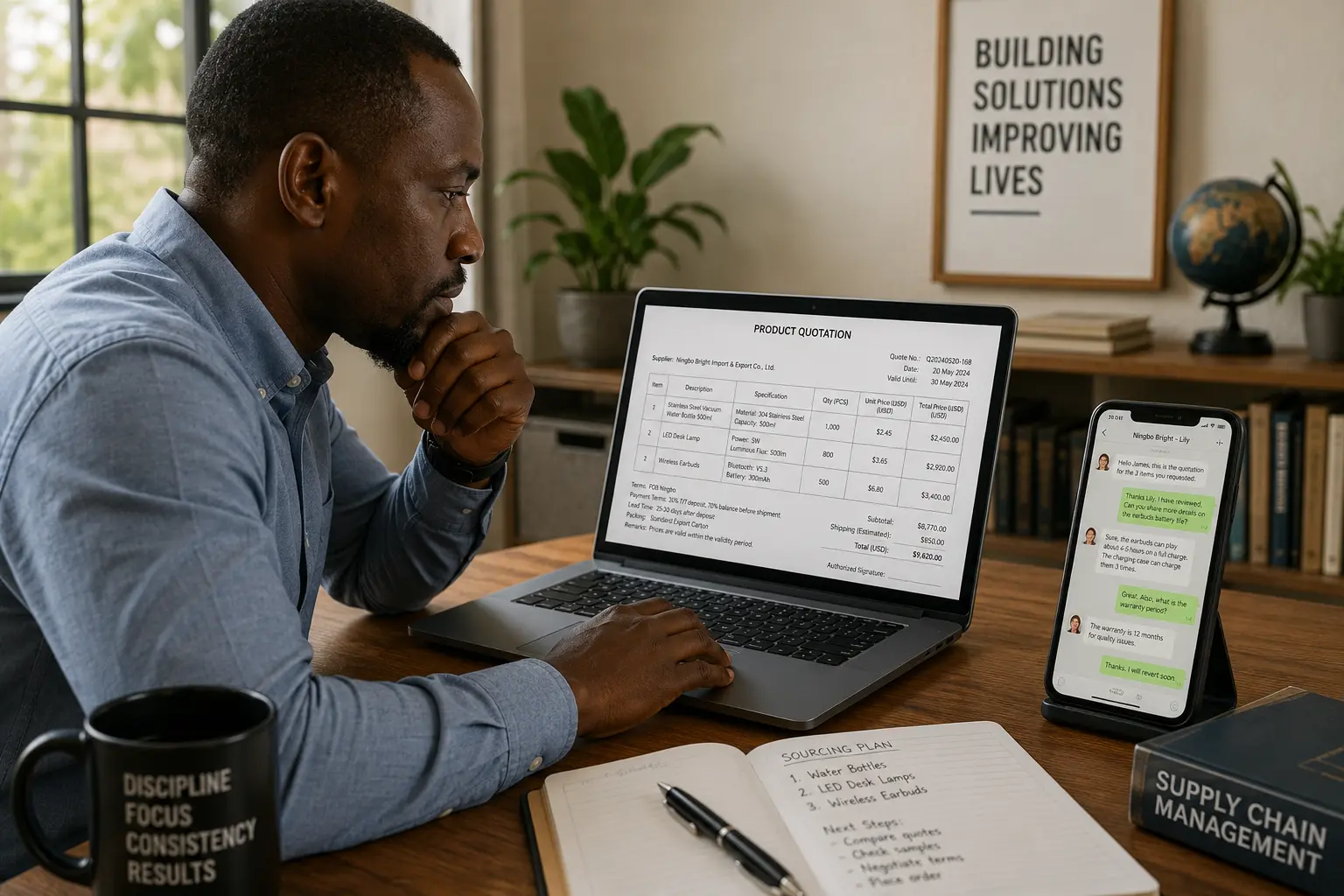

Alibaba Sample Kenya: Avoid This Costly Mistake 2026

An Alibaba sample Kenya order typically lands in Nairobi for 3,000 to 15,000 ksh once you add the product price, the sample markup most suppliers charge over bulk pricing, and express courier fees. It is not duty-free, and it is not always the cheapest way to verify a supplier.
This Pamoja Imports guide covers exactly how to request a sample from an Alibaba supplier, what it really costs landed in Kenya, how KRA treats sample shipments, and when using a sourcing agent with a team in China makes more sense than ordering a sample yourself.
Alibaba is the one major China sourcing platform a Kenyan importer can operate entirely alone. It has an English interface, accepts card and Trade Assurance payment, and does not require a Chinese phone number or bank account to use. That accessibility is exactly why an Alibaba sample Kenya order is worth understanding in detail, even though it is not where Pamoja Imports sources products.
We work from Pinduoduo and 1688, China’s domestic wholesale platforms, because the pricing is consistently lower once you have someone on the ground to access them. But most first-time importers start on Alibaba, and if you are testing a supplier before committing real capital, doing the sample stage correctly is the difference between a useful test and an expensive one.
This guide walks through the full process: how to request a sample, what it costs once courier and customs are factored in, and the specific mistakes that make a cheap sample turn into an expensive one. For the full picture of how Alibaba compares to the platforms we actually use, see our Alibaba vs 1688 Kenya importer guide.
Why Order a Sample Before a Bulk Order
An Alibaba listing shows you a product photographed under studio lighting, described by a supplier who wants your order. It does not show you the material the factory actually uses on a standard production run, how consistent quality is across units, or how the supplier communicates when something needs correcting. A sample answers all three, for a fraction of what a bad bulk order costs.
The risk is asymmetric in a way that matters more for a Kenya importer than for a buyer in a country with a shorter supply chain. If a UK or US buyer receives a bad bulk shipment, returning it to the supplier or disputing the charge through Trade Assurance is realistic.
Once goods clear KRA in Nairobi or Mombasa and reach you, re-exporting them to China for a refund essentially does not happen. Whatever arrives is what you have to sell, discount, or write off. That makes the sample stage the only point in the process where a mistake is still cheap to fix.
How to Request a Sample from an Alibaba Supplier
The process is straightforward, but the order of operations matters. Skipping steps is where most Kenyan buyers lose leverage before they have even placed a real order.
Message the supplier with a specific request
Do not ask “can I get a sample.” State the exact product, quantity you intend to order in bulk if the sample is approved, and any specification that matters to you: material, dimensions, color, branding. A vague request gets a generic reply. A specific one signals you are a serious buyer, which affects the price and attention you get.
Negotiate the sample price and shipping
Most Alibaba suppliers charge more per unit for a sample than for bulk, sometimes significantly more, because they are covering the cost of a one-off production run. Ask whether the sample cost is credited against your bulk order if you place one within an agreed window. Many suppliers will agree to this if asked directly, but almost none offer it unprompted.
Get the sample-credit answer in writing before payingChoose Trade Assurance where the order qualifies
If the sample order is placed and paid through Alibaba’s own checkout, Trade Assurance can apply and gives you a dispute path if the supplier does not send what was agreed. Paying a supplier directly outside the platform, which some will suggest to avoid Alibaba’s fees, removes that protection entirely.
Test the sample the way a customer will use it
A visual check is not enough. If it is a phone accessory, put a phone in it and drop it. If it is clothing, wash the fabric. The failure modes that matter are the ones your actual customers will find after purchase, not the ones visible on the shelf.

What to do if the supplier refuses a sample
Most established Alibaba suppliers will send a sample, though not always for free. A supplier who refuses outright, or who will only send a sample once you have paid for a bulk order in full, is telling you something important before you have committed any real money.
This is not automatically a scam, some smaller factories genuinely cannot justify a one-off production run for a single unit, but it should change how much you order on your first purchase. If a supplier will not send a sample at any price, shortlist a second supplier for the same product and compare responses. A supplier’s willingness to be tested is itself a signal worth weighing alongside price.
It also matters whether the refusal comes with an explanation. A supplier who says “our minimum sample order is 10 units because of tooling costs” is giving you a legitimate production constraint. A supplier who avoids the question entirely, or keeps redirecting you toward a bulk quote, is a weaker sign. Kenyan buyers new to Alibaba sometimes read persistence as good service, when in this specific case it is often the opposite.
What an Alibaba Sample Actually Costs to Kenya
The number that matters is not the sample price quoted on the Alibaba listing. It is the landed cost once product price, sample markup, and express courier to Nairobi are combined. Courier is usually the largest single line item on a light sample, which surprises most first-time buyers. Once you move from a sample to a bulk order, the question becomes does Alibaba ship to Kenya, and what the supplier’s shipping quote leaves out.
| Cost Component | Typical Range | Notes |
|---|---|---|
| Sample product cost | Varies by product | Often 20 to 100% above the equivalent per-unit bulk price |
| Express courier to Nairobi (0.5 to 2 kg) | Approx. 3,000 to 6,500 ksh | DHL and FedEx typically apply a minimum charge regardless of actual weight for light parcels. Confirm the current quote before paying, rates change and vary by courier and route. |
| Import duty, VAT, IDF | Based on declared value | Standard rates apply. IDF has a 5,000 ksh floor regardless of declared value, see the customs section below |
| Total for a simple, low-value sample | Approx. 3,000 to 8,000 ksh | Phone accessories, small hardware, similar light items |
| Total for a complex or custom sample | Approx. 10,000 to 15,000 ksh+ | Garments with custom specification, larger electronics |
The courier figures above are planning ranges based on typical express rates for light parcels on the China to East Africa lane, not a fixed quote. Always confirm the current DHL or FedEx price before committing, since courier pricing changes and depends on exact weight, dimensions, and any remote-area or fuel surcharge applied at the time.
The pattern worth internalizing: courier cost per kilogram on a light parcel is much higher than on a full shipment, because express couriers apply a minimum charge that a 0.3 kg sample cannot spread across enough weight to make efficient. This is the same economics that make consolidating orders cheaper than shipping items individually, covered in more detail in our guide to paying Chinese suppliers.

Kenya Customs Treatment of Alibaba Samples
This is the section where most generic sample-ordering guides get Kenya wrong, usually by omission, because none of them are written with Kenya’s customs rules in mind. Two facts matter here, and they are easy to conflate.
First: you do not need a Certificate of Origin for a sample shipment, or for most other imports. Kenya’s mandatory Certificate of Origin rule, in force from July 2025 to August 2026, was repealed by the Finance Act 2026 effective September 1, 2026. Samples of no commercial value were already exempt from that rule while it existed, but now that the general mandate is gone, this is simply the current rule for nearly all imports. Full breakdown in Certificate of Origin Kenya: Rule Killed in 2026.
It means you do not need to chase your Alibaba supplier for an origin certificate on a single sample unit, or on a bulk commercial shipment for that matter, unless you are separately claiming EAC, COMESA, or AfCFTA preferential tariff treatment, which would not normally apply to an Alibaba order.
Second: none of this affects duty, VAT, or the Import Declaration Fee.There is no blanket duty-free treatment for commercial samples in Kenya. Whatever value you declare on the sample shipment is assessed the same way any other commercial import is assessed: import duty based on the HS code, 16% VAT, and the IDF.
Do not declare a sample as a gift or leave the value blank to try to reduce this. Under-declaring is a customs offense in Kenya, and KRA cross-references declared values against its own valuation database.
This is worth knowing before you order, because it changes the math on whether a DIY sample is actually the cheapest way to verify a supplier. For a full breakdown of how IDF, VAT, and duty combine on any China import, see our Kenya import duty from China guide.
Mistakes Kenyan Buyers Make Ordering Alibaba Samples
Most of the cost overruns and disappointments Kenyan buyers report at the sample stage trace back to a handful of repeatable mistakes, not bad luck with a specific supplier. Watching for these before you pay for a sample saves both money and time.

Pamoja Imports: why most of our clients never order a separate sample
Of the clients who have sourced through Pamoja Imports, only one has ever purchased a standalone sample. That is not because the option is not there. It is because our Chengdu team already verifies the product in person before it is sourced, which does the job a sample exists to do for most standard orders.
- We source from Pinduoduo and 1688, not Alibaba, so pricing reflects domestic Chinese wholesale rates, not export markups
- Our team can arrange a sample sent to our Chengdu warehouse when a product genuinely warrants one: custom branding, a high-value first order, or a specification that photos cannot confirm. It runs on a 5,000 ksh deposit, credited against your order once you place the bulk purchase
- For standard products from a supplier we have already vetted, agent-side inspection typically replaces the need for a separate sample shipment and its courier cost
Frequently Asked Questions: Alibaba Sample Kenya
For more answers to common questions about importing from China to Kenya, visit our Kenya import FAQ page.
Budget 3,000 to 15,000 ksh total for most product categories, once you add the product cost, the sample markup suppliers charge over bulk pricing, and express courier to Nairobi. Simple items like phone accessories sit at the low end. Larger or custom items with express air courier can reach 15,000 ksh or more before any goods are even ordered in bulk.
No. There is no blanket duty exemption for commercial samples in Kenya. A Certificate of Origin is no longer a general requirement for Kenya imports as of September 2026, so that question does not even come up for most samples, but import duty, VAT, and the Import Declaration Fee still apply based on the declared value of the shipment, the same as any other commercial import.
No. Kenya’s mandatory Certificate of Origin rule was repealed effective September 1, 2026, so a Certificate of Origin is not required for a sample shipment or for most other imports. You still need a commercial invoice and accurate declared value. Full breakdown in Certificate of Origin Kenya: Rule Killed in 2026.
Most samples ship by express courier such as DHL or FedEx and arrive in Nairobi within 3 to 7 business days of the supplier dispatching it, plus whatever time the supplier needs to produce the sample itself, which can be 3 to 15 days for a custom item.
Sometimes. Many Alibaba suppliers will credit the sample cost against your bulk order if you place one within an agreed window, but this is a negotiation, not a guarantee. Ask the supplier directly before paying for the sample and get their answer in writing.
It depends on the product. For custom, branded, or high-value first orders, a physical sample is worth the cost regardless of who is sourcing. For standard products from a vetted supplier, a sourcing agent with a team physically in China, like Pamoja Imports, can inspect the product in person, which often removes the need for a separate sample shipment entirely.
Skip the courier bill, not the vetting
Tell us what you want to import and we will source it from Pinduoduo and 1688, verified in person by our Chengdu team before it ships, with one all-in rate covering duty, VAT, IDF, RDL, and delivery to Nairobi. No separate sample courier fee to plan for.
Submit a Source Request
Jonatan Sirak sirak.se
Founder of Pamoja Imports, a Kenya-China import agency with an operations team based in Chengdu, China. With several years of hands-on experience facilitating shipments across electronics, solar equipment, construction materials, and consumer goods, he helps Kenyan entrepreneurs source and import products profitably. He splits his time between Nairobi and Chengdu.