
How to Negotiate with Chinese Suppliers: A Kenya Importer’s Guide 2026
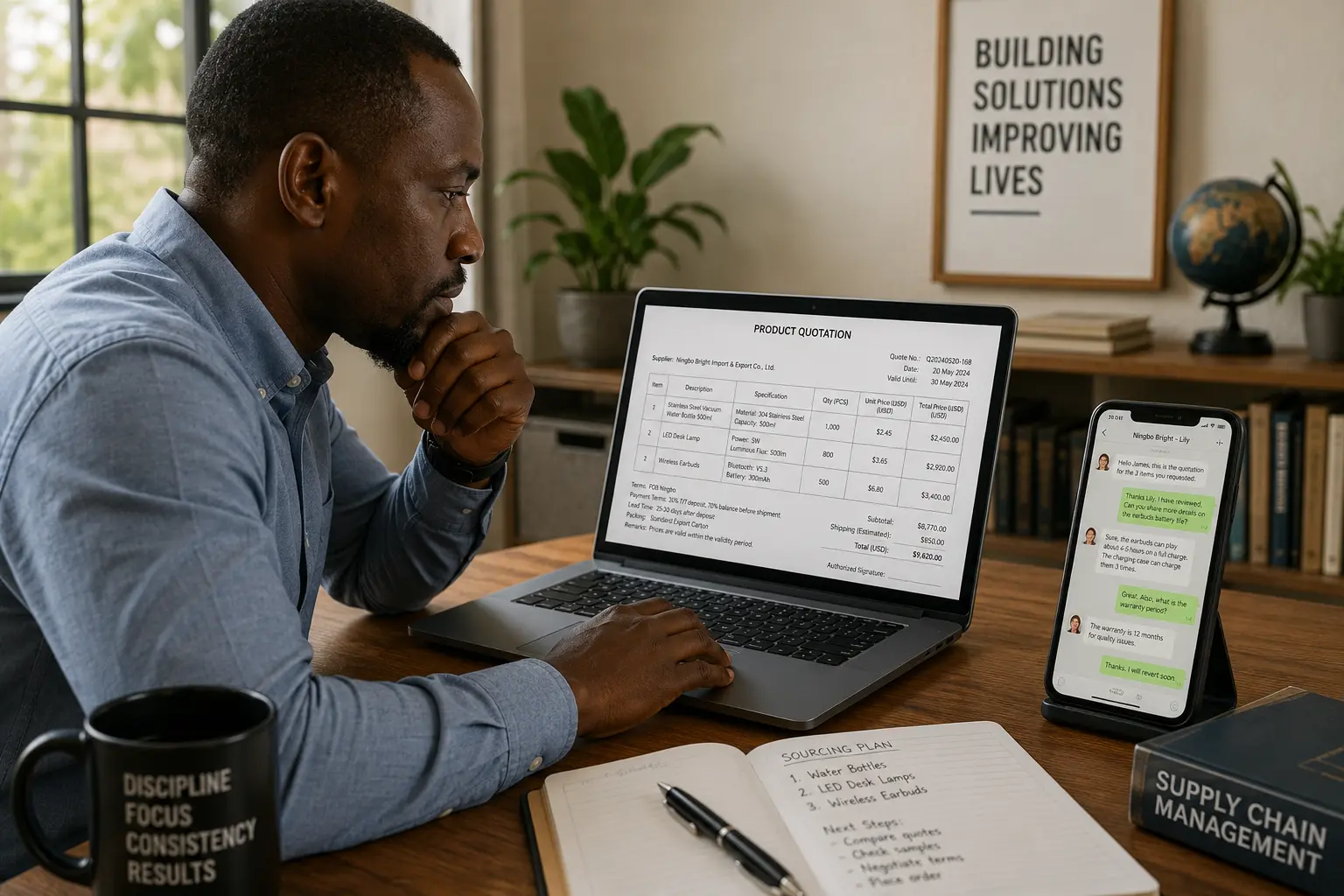
Knowing how to negotiate with Chinese suppliers comes down to three things: what they care about, what leverage you have as a buyer, and which platform you are sourcing from. On Alibaba, negotiation is in English and mostly about price and MOQ. On 1688 and Pinduoduo, it happens in Mandarin and requires a different approach entirely. This guide covers both, with real scripts you can use or adapt.
- The Right Negotiation Mindset
- Before You Contact Any Supplier
- Platform-by-Platform Negotiation Guide
- How to Negotiate a Better Price
- How to Negotiate a Lower MOQ
- Negotiating Quality Standards Before You Order
- Negotiation Scripts You Can Use Today
- Mistakes That Cost Money When You Negotiate with Chinese Suppliers
- Frequently Asked Questions
Most guides on how to negotiate with Chinese suppliers are written for Amazon FBA sellers ordering 500+ units from verified factories. That is not the situation most Kenya importers are in. You might be placing a 30,000 to 80,000 ksh test order with a supplier you found on 1688 last week, communicating through a translation app, and trying to bring the unit price down by 10% without losing the deal.
This guide is written for that situation. We draw on daily experience from our Chengdu team who negotiate in Mandarin with Chinese factories on behalf of our Kenya clients. If you are not yet sure whether to negotiate yourself or use a sourcing agent, see our sourcing agent vs freight forwarder guide first. The tactics here are what actually works at small and medium order sizes, on the platforms Kenyan importers actually use.
The Right Negotiation Mindset
Before you learn how to negotiate with Chinese suppliers, understand the dynamic you are walking into. Chinese suppliers, especially on domestic platforms like 1688 and Pinduoduo, receive hundreds of inquiries. They are experienced at reading buyers. They know when someone is new, when someone is price-shopping without intent to buy, and when someone is a serious buyer worth giving a good deal to.
Your goal in every negotiation is to signal that you are a serious, repeat buyer, even on a first order. That framing changes everything. A supplier who thinks you will order once and disappear has no incentive to give you their best price. A supplier who thinks you will become a regular customer has every incentive to make the first order work.
On pricing: negotiation is completely standard in Chinese business culture. Suppliers quote expecting to be negotiated down. If you accept the first price, you have almost certainly left money on the table. A polite counter is not rude. It is expected.
If you are still in the early stages of setting up your import business, our guide on how to start an import business in Kenya covers product selection, registration, and supplier vetting before you get to the negotiation stage.
Before You Contact Any Supplier
The single biggest mistake when you negotiate with Chinese suppliers is starting a conversation without preparation. Here is what you need before you send your first message:
Know your target price
Before you contact anyone, research the market price for your product on multiple suppliers. On 1688, search the product and look at the price range across 10 to 15 listings. Your target negotiation price should be near the lower end of that range, not below it. Unrealistically low counters end negotiations immediately.
Know your acceptable MOQ
Decide before you negotiate what quantity you can actually commit to. If you need 50 units, your target MOQ is 50 units. Know this number before the conversation starts so you are not making decisions under pressure mid-negotiation.
Identify at least two competing suppliers
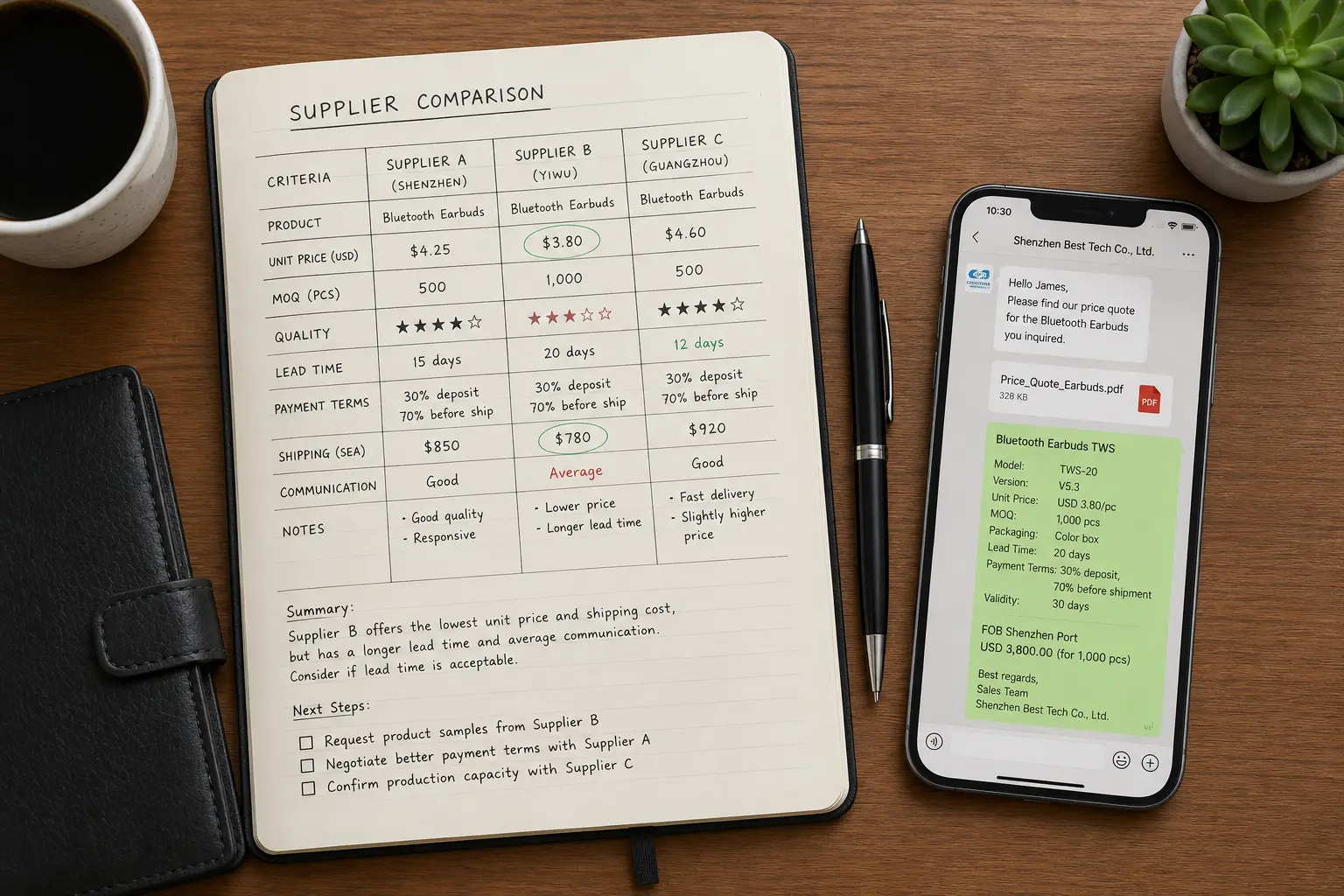
Having alternatives is your strongest negotiation tool. If you are talking to one supplier with no backup, you have no leverage. Contact three to five suppliers for the same product. Their quotes give you real market data and real competitive pressure you can reference in negotiations. Before contacting any supplier, make sure they are properly vetted. Our guide on finding reliable Chinese suppliers covers the full vetting process.
Understand what you can trade
Price is not the only thing you can negotiate. Think about what you can offer in exchange for a lower price or MOQ. Each of these has real value to a supplier:
- Faster payment. Paying 100% upfront rather than the standard 30% deposit / 70% before shipment eliminates the supplier’s risk of a buyer backing out mid-production. This is genuinely valuable to them and worth a 5 to 10% price reduction in most cases.
- For a full guide on which payment methods are safest and how to send money from Kenya to China, see our How to Pay Chinese Suppliers: Payment Methods for Kenya Importers 2026.
- Simpler packaging. Custom printed boxes have their own production MOQ, often 500 to 1,000 units. If you accept plain brown boxes or a simple sticker label for your first order, the supplier’s cost drops and their MOQ barrier disappears.
- Flexible lead time. Rush orders cost more because they disrupt production scheduling. If you tell the supplier “we are not in a rush, take 30 days if needed,” you remove pressure from their production line and that flexibility has a price.
- Commitment to future orders with specific numbers. “We plan to reorder” is weak. “We plan to order 200 units per month for the next six months” is strong. Specific numbers make the future order feel real and give the supplier something to factor into their margin calculation.
Platform-by-Platform Negotiation Guide
The platform you are sourcing from determines the negotiation environment almost entirely. What works on Alibaba will not work on 1688.
English. Structured. MOQ-flexible.
Suppliers are set up for international buyers. Use the RFQ system. Negotiate by email or Alibaba chat in English. Trade Assurance protects your payment. Most suppliers here have experience negotiating with overseas buyers and expect it.
English OKMandarin required. Best factory prices.
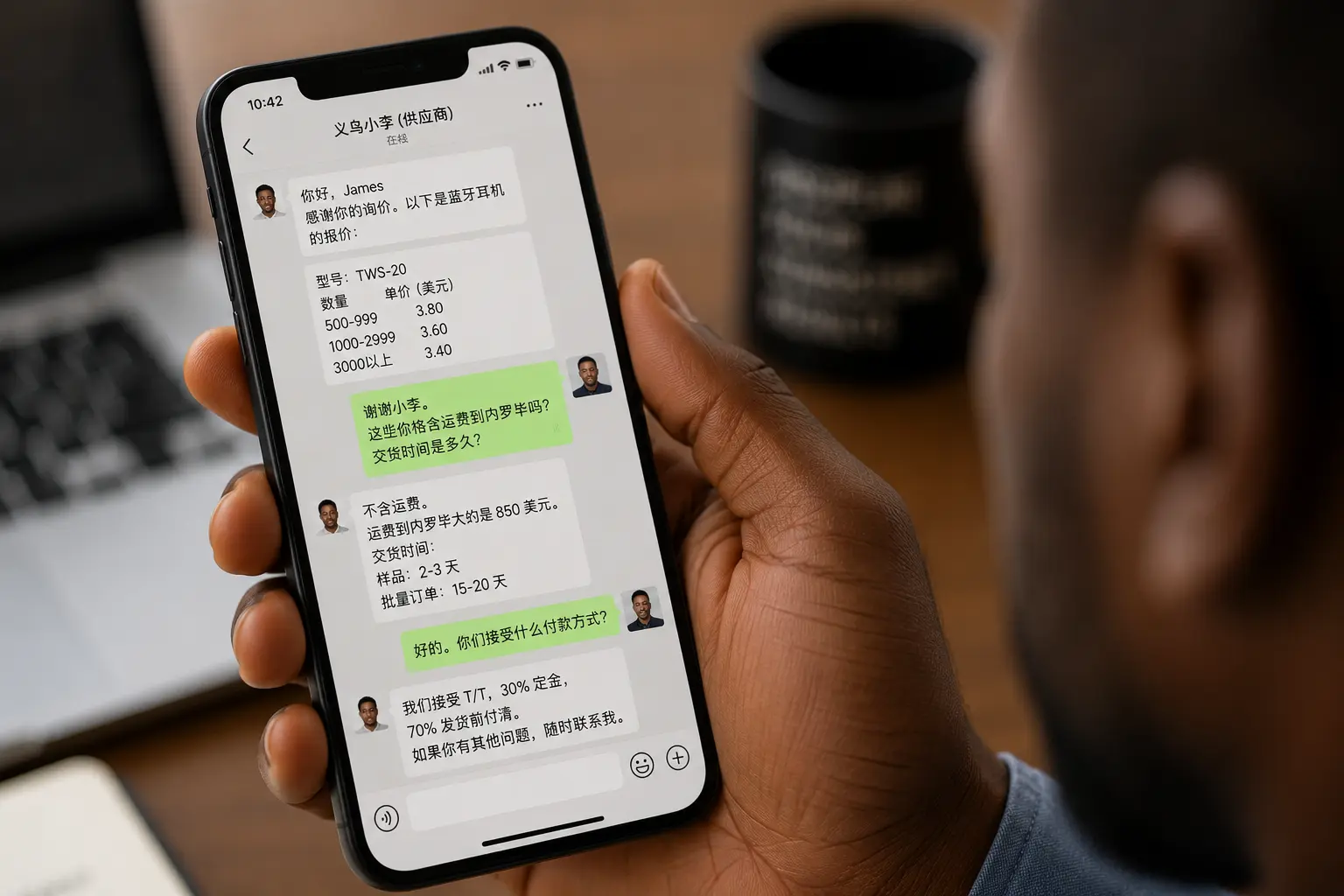
Domestic Chinese wholesale platform with prices 20 to 40% lower than Alibaba. Suppliers are not set up for international buyers and rarely respond to English messages. Negotiation happens via in-app chat (旺旺 / Wangwang) in Mandarin. The flow: find the product listing, click the chat button, introduce yourself as an overseas buyer, state your quantity and ask for their best price. Having a Mandarin-speaking agent do this natively gets significantly better responses and prices than translation tools.
Mandarin neededGroup buy model. Price non-negotiable.
Price on Pinduoduo is largely fixed. The platform’s model is bulk pricing by volume tier. Focus on selecting the right quantity tier rather than negotiating the unit price. Our team sources from Pinduoduo regularly for standard consumer goods where prices are already the lowest available.
Price fixedFor most Kenya importers, Alibaba is the right starting platform for negotiation practice. Once you have established supplier relationships and are working with a Mandarin-speaking agent, 1688 is where you access the best prices. Our Alibaba vs 1688 guide covers which platform to use at each stage of your import journey. For a broader overview of the entire sourcing and import process, see our complete guide to importing from China to Kenya.
How to Negotiate a Better Price
Price negotiation with Chinese suppliers follows a fairly predictable pattern once you understand the structure. Here is how it works at each stage.
Never accept the first quote
The first quote is almost never the best price. Suppliers build negotiation room into their initial figure. A simple, polite response: “Thank you for the quote. Our target price is X. Can you work with this?” This will typically get you a better offer. This costs you nothing and the worst outcome is that they say no.
Use competing quotes as leverage
If you have quotes from three suppliers, use the lowest quote as your reference point. “We have received a quote of X per unit from another supplier for the same product. Can you match or beat this price?” This is standard practice and not considered aggressive. It gives the supplier a specific target rather than an open-ended request.
Counter at 10 to 15% below their quote
For most products on 1688 and Alibaba, countering at 10 to 15% below the quoted price is reasonable and will usually result in a settlement somewhere in between. Countering at 30% or more below sends a signal that you are not a serious buyer and will often end the negotiation. If your target price is significantly below their quote, explain why: reference competing quotes, your volume plans, or simplified packaging requirements.
Ask what drives the price
Sometimes a lower price is achievable by changing something about the order: plain packaging instead of custom, a standard colour instead of a custom colour, a slightly different specification. Ask the supplier: “What would need to change about the order for you to offer a lower price?” This opens a conversation that pure price negotiation does not.
Reference long-term volume
If you plan to reorder regularly, say so explicitly with numbers. “We are testing with 100 units this order but plan to increase to 500 units monthly if quality meets our standard.” This changes the supplier’s calculation. A small first order from a buyer who becomes a regular 500-unit-per-month customer is worth far more than a one-time 500-unit order.
How to Negotiate a Lower MOQ
MOQ (minimum order quantity) is one of the biggest barriers for Kenya importers starting out. A supplier listing “MOQ: 500 units” can feel like a wall. In most cases, it is not. Here is how to get through it.
Understand why the MOQ exists
MOQs are set for different reasons depending on the product. For some products, it is about production economics: the factory needs to run a minimum batch to make the setup cost worthwhile. For others, it is about packaging: custom printed boxes have their own MOQ separate from the product itself. For trading companies, it is often arbitrary. Understanding the reason lets you address it directly.
Offer a higher unit price in exchange
The most reliable MOQ negotiation tactic: offer to pay more per unit for a smaller quantity. A supplier with MOQ 200 units at 500 ksh per unit might accept 50 units at 600 ksh per unit. Their revenue is similar, their setup cost is covered, and you get a test order size that matches your budget. The premium you pay on the first order is often less than the cost of unsold stock if the product does not move.
Ask about plain packaging
If the MOQ is driven by custom packaging, ask whether you can use plain or generic packaging for the first order. This is a common solution. You get your 50 units with plain boxes, test the market, and switch to custom packaging once you know the product sells. Ask the supplier directly: “What is the MOQ without custom packaging?”
Split the order across a longer timeline
Some suppliers will accept a lower initial shipment if you commit to taking the full MOQ quantity across two or three shipments. “Can we order 100 units now and 200 units in 30 days?” This works better with suppliers you already have a relationship with, but is worth trying on a first order too.
Negotiating Quality Standards Before You Order
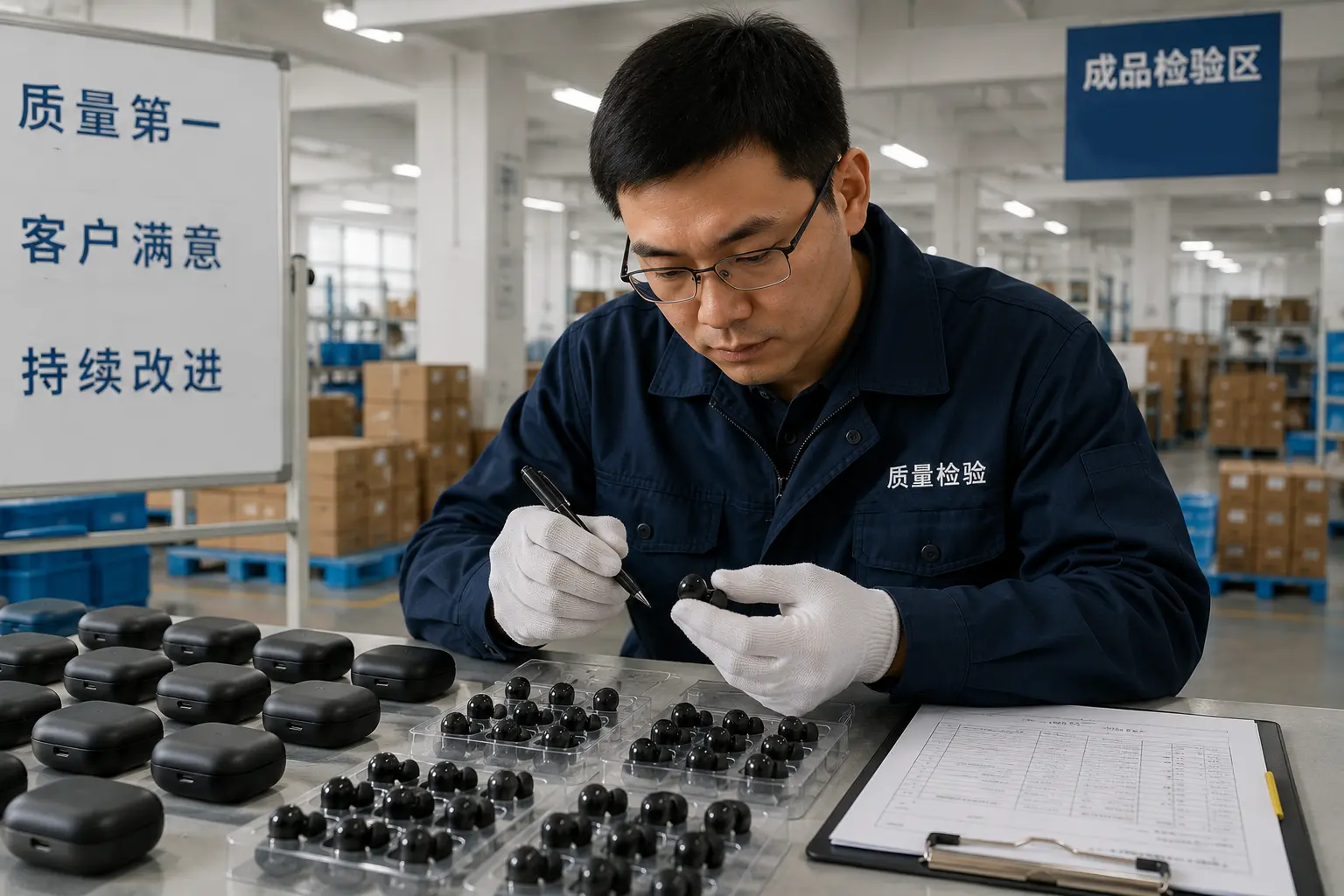
Price and MOQ get all the attention, but quality standards are what actually determine whether your order is usable when it arrives. Setting these upfront, in writing, is part of the negotiation most Kenya importers skip entirely.
Define your quality expectations before you agree on price
In Chinese business culture, quality and price are linked. If you push for a very low price, the supplier may quietly reduce quality to protect their margin. Making your quality standard explicit before you finalise the price prevents this from being a variable. State the materials, dimensions, and any compliance requirements before you settle on a number.
Request a pre-production sample
Before production starts on any order above 50,000 ksh, request a pre-production sample or a production sample for approval. This is standard practice and a reasonable supplier will agree. Getting this in writing in your order confirmation is important: if the final goods do not match the approved sample, you have grounds for a dispute.
Ask about pre-shipment inspection
For larger orders, negotiate the right to a pre-shipment inspection before the goods leave China. This can be done by our Chengdu team on your behalf, or by an independent inspection company. Catching a quality problem before shipment costs a fraction of what it costs to deal with it after the goods arrive in Nairobi. Our sourcing service includes pre-shipment inspection on request for larger orders.
Negotiation Scripts You Can Use Today
These are message templates adapted from real conversations our Chengdu team has used to negotiate with Chinese suppliers on behalf of Kenya clients. Adjust the specifics to your product, quantities, and situation.
Opening message: price negotiation on Alibaba
Hello, thank you for your quotation. We are interested in your and have been reviewing several suppliers. Your product looks good but your unit price of [X] is above our target. We have received quotes of [Y] per unit from other suppliers for similar quality. Our target price is [Z] per unit for [quantity] units. If you can work with this price, we are ready to proceed with a sample order this week. We plan to order monthly if the quality meets our standard.
MOQ negotiation: asking for a smaller first order
We are very interested in your product but our first order needs to be [X] units, not [MOQ] units. This is a market test for us. If this product sells well in our market, we plan to increase to [larger quantity] units per month within 60 days. We are happy to pay a slightly higher unit price for the smaller first order. Would [price per unit] work for [X] units?
Competing quote leverage
We have received a quote of [competitor price] per unit from another supplier for this product. We prefer to work with you based on your product quality and reviews, but we need to be competitive in our pricing. Can you match [competitor price] per unit for our order of [quantity] units?
Long-term volume commitment
We are building a long-term supply relationship for this product category. Our first order is [quantity] units but we expect this to grow to [larger quantity] per month as we scale our sales. We are looking for a supplier who can give us a good price now in exchange for consistent volume going forward. Our target price is [X]. Is this something you can work with?
您好,我们是肯尼亚的进口商,对您的产品很感兴趣。您报价[X]元,我们的目标价格是[Y]元,数量[Z]件。如果价格合适,我们希望长期合作,每月稳定下单。请问能否接受我们的目标价格? (Translation: “Hello, we are importers from Kenya and are very interested in your product. Your quoted price is [X] RMB. Our target price is [Y] RMB for [Z] units. If the price works, we hope to cooperate long-term and place stable monthly orders. Can you accept our target price?”)
Running scripts through a translation tool helps but a native Mandarin speaker gets significantly better responses and prices. Our Chengdu team handles 1688 and Pinduoduo negotiations as a standard part of the sourcing service.
Mistakes That Cost Money When You Negotiate with Chinese Suppliers
These are the patterns we see most often from Kenya importers who try to negotiate with Chinese suppliers and either lose the deal or pay more than they should.
Revealing your maximum budget
Never tell a supplier what your maximum budget is. If you say “our budget is 50,000 ksh,” your quote will be 50,000 ksh. Give them a target price instead, which leaves room for a counter that is still within your budget.
Negotiating too aggressively on a first contact
Opening with a very low counter on the first message signals that you are a difficult buyer. Suppliers de-prioritise difficult buyers. A better approach: open with a reasonable counter, establish rapport, and save aggressive negotiation for when you have built some trust over a few messages.
Only talking to one supplier
With no alternative, you have no leverage. Always contact at least three suppliers for the same product. Even if you prefer one, the others give you real competitive data and genuine negotiating power. Our supplier finding guide explains how to identify and vet multiple options efficiently.
Threatening to leave and then not leaving
“I will go to another supplier” is a powerful statement, but only if you mean it. If you say it and then immediately accept their price, your credibility is gone for every future negotiation with that supplier. Only use it if you are genuinely prepared to walk.
Ignoring payment terms
Most importers focus entirely on unit price and ignore payment terms. But payment terms affect your cash flow significantly. Pushing for 50% upfront rather than 100% upfront, or negotiating a longer lead time that lets you pay closer to the ship date, can be worth more than a 5% unit price reduction on a large order. Always negotiate terms, not just price.
Not calculating the full landed cost before negotiating
The supplier price is only part of your total cost. Import duty, VAT, IDF, RDL, and freight all affect your margin. Negotiate based on your full landed cost, not just the FOB price. Use our shipping calculator and duty guide before you set your target price. Watch for suppliers who propose writing a lower value on the invoice once you’ve agreed a price: the penalty for that lands on you, not them.
Pamoja Imports negotiates in Mandarin so you do not have to.
Our Chengdu team negotiates directly with Chinese factories on 1688, Pinduoduo, and Taobao in Mandarin. This consistently yields 10 to 20% better pricing than English-language negotiation, and gets MOQ flexibility that most overseas buyers cannot access on their own.
- Direct negotiation in Mandarin with factory staff
- Multiple supplier quotes compared before we commit
- MOQ negotiation included as standard for all orders
- First 10 sourcing requests free. Then 5,000 ksh deposit per order, deducted from order value
Frequently Asked Questions
For more answers to common questions about importing from China to Kenya, visit our Kenya import FAQ page.
Yes, but the approach differs from Alibaba. On 1688, negotiation happens through in-app chat in Chinese. Messaging in Mandarin, even via a translation tool, significantly improves response rates and outcomes. Requesting a lower MOQ or better price is common and expected, especially if you reference a competing supplier’s price. On Pinduoduo, prices are largely fixed by volume tier. The platform’s model is bulk pricing, so focus on selecting the right quantity tier rather than negotiating the unit price.
For stock products on platforms like 1688, you can typically negotiate 5 to 15% off the listed price for small orders. For larger orders above 50,000 ksh goods value, 10 to 20% is realistic. Custom or OEM products have less room for price negotiation, but MOQ and payment terms are often more flexible. Our Chengdu team regularly achieves 10 to 20% better pricing than buyers negotiating in English directly.
Lead with a long-term commitment. Tell the supplier this is a test order and if quality meets your standard, you plan to order regularly. Offer to pay a slightly higher unit price in exchange for a lower MOQ. Find out what is driving the MOQ. It is often packaging, not the product itself. Offer to use plain packaging for the first order. Ask directly: “What is the MOQ without custom packaging?”
On Alibaba, English is standard and most suppliers have English-speaking staff. On 1688 and Pinduoduo, Chinese is almost always required. Suppliers on domestic platforms are not set up for international buyers, so messaging in Mandarin dramatically improves response rates. Working with an agent who communicates in Mandarin natively yields the best results, which is exactly what Pamoja Imports does for our Kenya clients.
No. Negotiation is completely expected in Chinese business culture, especially from a new buyer. Suppliers factor negotiation into their initial quote. The key is to be respectful and businesslike, never aggressive or dismissive of their constraints. Framing negotiations as a long-term relationship rather than a one-time transaction gets better results.
Never reveal your maximum budget: your quote will hit that number exactly. Never threaten to leave and then immediately stay, it destroys your credibility for all future negotiations with that supplier. Never counter at more than 25 to 30% below their quote as it signals you are not a serious buyer. And never skip the sample order. The negotiation is not complete until you have verified the product quality matches what was agreed.
Let our Chengdu team negotiate with Chinese suppliers for you
Send us the product you want to import. We will find verified suppliers, negotiate in Mandarin, and get you the best price before you spend a single ksh.
Chat with us on WhatsApp
Jonatan Sirak sirak.se
Founder of Pamoja Imports, a Kenya-China import agency with an operations team based in Chengdu, China. With several years of hands-on experience facilitating shipments across electronics, solar equipment, construction materials, and consumer goods, he helps Kenyan entrepreneurs source and import products profitably. He splits his time between Nairobi and Chengdu.